Category: Family Names

  • Edward and Elizabeth (nee Mackey) Comber

    Edward Comber was born on December 20, 1820, in Spitalfields, London, England, to James Robert Comber and Elisabeth Lowe. By December 7, 1821, he had connections to St. Leonard’s Workhouse in Shoreditch, Middlesex, England. On June 24, 1834, he embarked from Cobh, Cork, Ireland, aboard the *Blenheim*, a ship carrying mostly Irish convicts. The vessel arrived in Sydney, New South Wales, on November 14, 1834, after a voyage of 110 days.

    At the age of 15, Edward enlisted in the British Army on October 15, 1835, in Windsor, New South Wales. He served in the 50th Regiment of Foot with military service number 1105. His military service lasted until November 3, 1845, and included participation in the Gwalior Campaign, specifically the Battle of Punniar on December 29, 1843. After his discharge, he settled in New South Wales. By February 15, 1851, he was residing in Mittagong, where he applied for an Irish Famine Orphan.

    Elizabeth Mackey, born on March 7, 1831, in Strahan, Tasmania, Australia, was the daughter of Edward Mackey and Ann Taylor. She was baptized on March 27, 1831, at the Wesleyan Church in Hobart. During her early years, she had connections to the workhouse in Cootehill, Cavan, or Cootehill, Monaghan, Ireland. Between February 2, 1840, and 1844, she lived at the Madras Female Orphan Asylum in Chennai, Tamil Nadu, India. The circumstances surrounding her early life and that of her siblings remain unclear between September 7, 1836, and February 2, 1840.

    Elizabeth was literate and able to read and write. On December 6, 1849, she departed from Plymouth, Devon, England, aboard the John Knox, arriving in Sydney, New South Wales, on April 29, 1850. She was part of the Irish Famine Orphan Scheme and traveled with her sister Sarah.

    On July 21, 1851, Edward Comber and Elizabeth Mackey were married at the Parish of St. Philip in Sydney, with William Cowper officiating. Edward was 31, and Elizabeth was 20. They had twelve children, the first born when Elizabeth was 21 and the last when she was 41.

    Edward worked as a storekeeper in Mulgoa, New South Wales, where he was recorded on May 20, 1853, at the baptism of their daughter Elizabeth. On May 5, 1857, a newspaper report placed him in Rutherford, New South Wales, after he was found wandering in the bush.

    By the late 19th century, the couple had settled in Bundella, New South Wales. Elizabeth Mackey died there on May 18, 1880, at the age of 49, due to typhoid fever. She was buried the next day in Bundella. Her death was recorded in The Singleton Argus and Upper Hunter General Advocate on May 26, 1880.

    Edward was recorded in the 1891 Australian Census. He later moved to Armidale, New South Wales, where he passed away on July 31, 1900, at the age of 79. His cause of death was a cerebral hemorrhage and ulceration of the leg, with the illness lasting 48 hours. He was buried in the Armidale Catholic Cemetery. A newspaper article mentioning him was published in the Uralla Times on August 1, 1946.

    Both Edward and Elizabeth have documented genetic lineages. Elizabeth’s maternal DNA belongs to the mtDNA haplogroup J1c2, and Edward’s maternal DNA is also recorded. Their most recent common ancestor is linked to Edward Comber and Elizabeth Mackey. Their burial locations are recorded with GPS coordinates, and Elizabeth has a FindAGrave memorial under ID 238103636. They are recognized as second great-grandparents of a descendant named Megan.

  •  Narrative: The Life and Legacy of Elizabeth Comber

     Narrative: The Life and Legacy of Elizabeth Comber

    This is a brief narrative of the life of Elizabeth Comber, one of my maternal great-grandmothers. There is more to add…

     Early Life

    Elizabeth Comber, born on 20 May 1853 in Mulgoa, New South Wales, was the daughter of Edward Comber and Elizabeth Mackey. Her baptism took place on 24 June 1853 at St Thomas Parish in Mulgoa. The family resided on the Fernhill estate, where Edward worked as a storekeeper. Her mother, Elizabeth Mackey, was born in 1831 in Macquarie Harbour, Tasmania, and had an eventful early life, being orphaned after her father, Sgt. Edward Mackey, passed away in India. She later emigrated to New South Wales in 1850 as part of the Irish Famine Orphan Scheme.

    Elizabeth’s childhood coincided with pivotal moments in Australian colonial history, including the gold rush era. She spent part of her early life on the Turon goldfields, living with her aunt and uncle, Dr. Walker, a government medical officer. These experiences left Elizabeth with vivid memories of the bustling goldfields and the excitement of mounted gold escorts.

     First Marriage: A Tumultuous Start

    At the young age of 13, Elizabeth married John Thomas Rowley on 2 January 1867 at the Coonamble Courthouse. This early marriage proved problematic. In 1882, John was arrested for bigamy after marrying another woman, Sarah Ann Richards, while still married to Elizabeth. This likely contributed to the end of their union.

     A Relationship with John Fitzsimmons

    Elizabeth entered a de facto relationship with John Fitzsimmons between 1868 and 1872. Fitzsimmons, born in 1843 in Leicester, England, immigrated to Australia aboard the Ben Nevis in 1855. Together, they had two daughters:

    1. Elizabeth Hannah Fitzsimmons (b. 1869, Quambone).

    2. Matilda Lillas Fitzsimmons (b. 1871, Dungog).

    This relationship was complicated by societal norms and legal constraints, as Elizabeth was still legally married to Rowley. Historical speculation suggests that Fitzsimmons may have been a controversial figure, described in police records as a labourer and boxer involved in various incidents. John was eventually convicted in 1886 of the manslaughter of another of his de factos, Sarah Jane Beckingham.

     Second Marriage: Building a Legacy with Robert Hardy

    Elizabeth married Robert Hardy on 24 February 1887 in Dangar Village, Narrabri. Hardy, born in 1833 in Sydney, was a grazier and landowner. Together, they built a prosperous life, managing properties such as “Mollie View” and “Bell’s Mount.” They had seven children:

    1. Arthur Ernest May HARDY (b. 1876, Gunnedah).

    2. Alice Amelia Hardy (b. 1882, Narrabri).

    3. Isabella Sarah Hardy (b. 1885, Narrabri).

    4. Andrew Robert Hardy (b. 1887, Narrabri).

    5. Percival James Hardy (b. 1889, Narrabri).

    6. Jessie Teresa Hardy (b. 1891, Narrabri).

    7. Olive Blanch Hardy (b. 1893, Narrabri).

    Robert Hardy passed away in 1907, leaving Elizabeth to manage their properties and care for their children.

     Later Life and Legacy

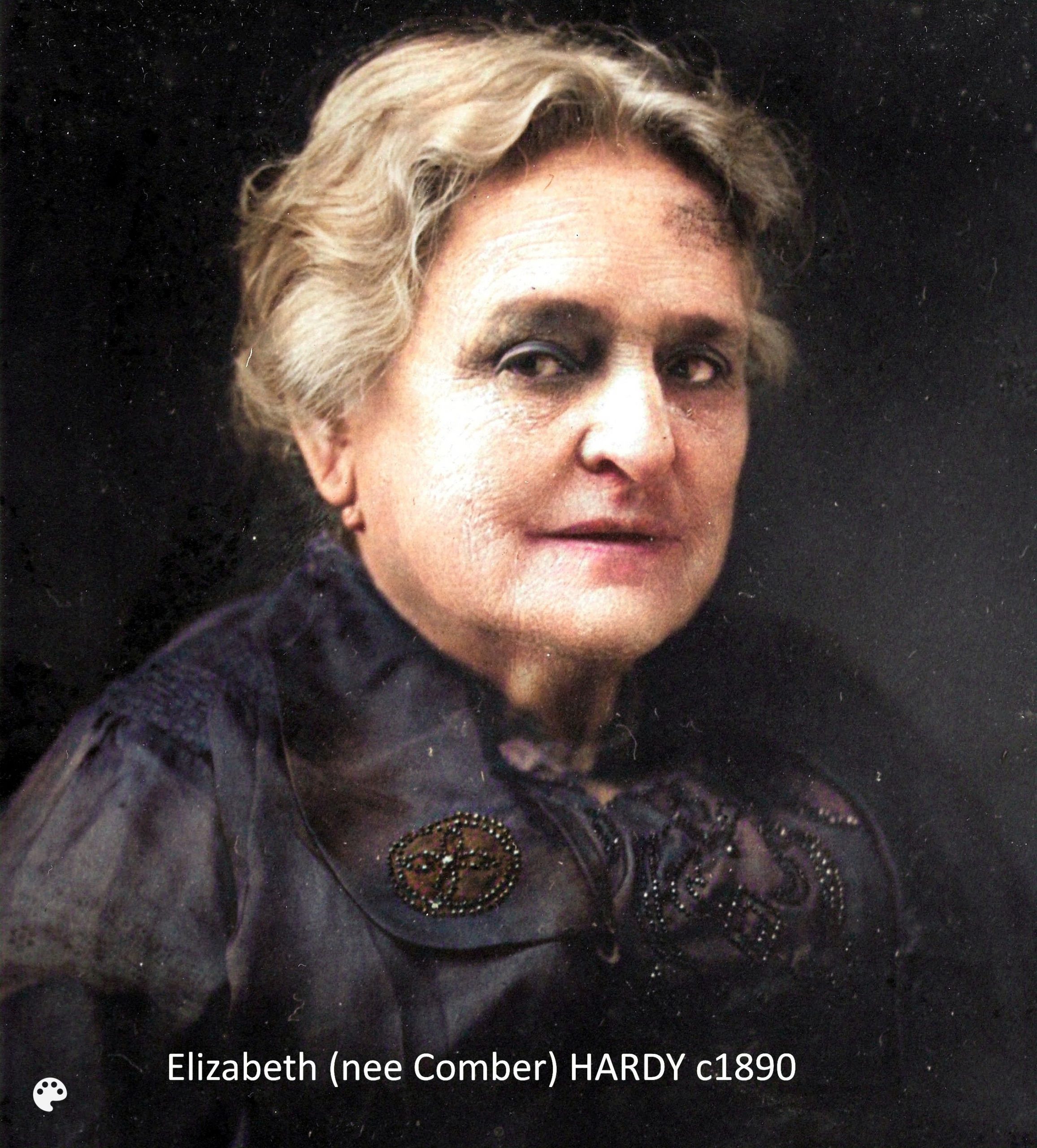
    Elizabeth spent her later years in “Rose Cottage” on Maitland Street, Narrabri, which she converted into a nursing home. She died on 21 May 1927 from heart disease and was buried in Narrabri Cemetery.

    Elizabeth’s life story reflects the complexities of colonial Australia, marked by immigration, marriage controversies, and the challenges of pioneering life. Her descendants spread across New South Wales, contributing to the development of communities like Narrabri, Dungog, and Coonamble.

     Table of Individuals, Events, and Places

     Individuals                                                                                                                             

     Elizabeth Comber  Born 20 May 1853, Mulgoa; married John Rowley (1867), de facto with John Fitzsimmons, married Robert Hardy.  
     Edward Comber     Father, born 1820, Spitalfields, England; storekeeper; died 1900, Armidale.                          
     Elizabeth Mackey  Mother, born 1831, Tasmania; orphaned; emigrated to NSW (1850); died 1880, Bundella.                 
     John Rowley       First husband; charged with bigamy (1882).                                                           
     John Fitzsimmons  De facto partner; father of two daughters; controversial figure.                                     
     Robert Hardy      Second husband; grazier and landowner; died 1907, Narrabri.                                          

     Events                                                                                                                                    

     Birth and Baptism Born and baptized in Mulgoa, 1853.                                                                   
     Gold Rush Era     Early life on Turon diggings, experiencing gold escorts.                                             
     First Marriage    Married John Rowley at 13 (1867); ended after bigamy charges.                                        
     De Facto Partner  Relationship with Fitzsimmons (1868–1872).                                                          
     Second Marriage   Married Robert Hardy (1887); built a legacy in Narrabri.                                            
     Property Legacy   Managed properties: Mollie View, Bell’s Mount.                                                      
     Later Life        Ran Rose Cottage as a nursing home; died in 1927.                                                   

    Places                                                                                                                                      

     Mulgoa            Birthplace and baptism site.                                                                        
     Turon Goldfields  Early residence during gold rush.                                                                   
     Coonamble         First marriage location (1867).                                                                     
     Narrabri          Long-term residence; properties and later life nursing home.                                        
     Dungog            Residence during relationship with Fitzsimmons.                                                     
     Quambone          Birthplace of Elizabeth Hannah Fitzsimmons (1869).                                                 

    This narrative ties together the rich tapestry of Elizabeth Comber’s life and legacy, clarifying confusing elements such as her multiple relationships and the socio-historical context of her experiences.

  • The Hill Family in the England Censuses

    I’ve been trying to determine Ellen Clarke Hill Measom’s birth name, and finally found references in the 1841, 1851 and 1861 England Censuses. I also found a Birth Registration for Ellen Clarke Hill in 1848 in Billesdon (FreeBDM).  

    In 1841, the Hills had returned to England from India, after James Bird (Hill) had died when the 2nd Foot (Queen’s Royal) fought at the Battle of Ghazni on 31 Jul 1839, either from wounds or illness. Ann nee Jarvis, widow of James Bird (Hill) is shown as the head of the house in Burton Overy with her two sons John and James, and two daughters, Sarah and Esther.  

     Name         Sex  Age Occupation  Birth Place
     Ann Hill       F   35             
     John Hill     M   15             
     James Hill  M   14             
     Sarah Hill  F   12             
     Esther Hill F   10             
    1841 Census of England: Burton Overy, Leicestershire, England


    In 1851, some of the children have married and have families of their own in Burton Overy:

    • Ann nee Jarvis is the head of her house with her daughter Ester and granddaughter Ann, daughter of Ester.
    • She has a Lodger, William Berd, most probably a relation of the Birds (James Bird Hill’s mother’s family)
    • Son James has married Jane nee Smalley and his sister Sarah is living in the same house with her daughter shown as Sarah, but is most probably Ellen, as she has the same birth year (1848) as Ellen, and is shown as James’ niece.  
    • There is no sign of son John Hill in Burton Overy.

     Name  Relation Status  Sex  Age Occupation  Birth Place
     Ann Hill Head  F 49  Birmingham, Warwickshire, England
     Ester Hill Daughter  F 20  East Indies British Subject
     Ann Hill Granddaughter  F 3  Burton Overy, Leicestershire, England
     William Berd Lodger  M 50  Kings Norton, Leicestershire, England
    1851 Census of England: Burton Overy, Leicestershire, England

    Name       Relation Status Sex Age Occupation Birth Place
     James Hill Head            M   25             India
     Jane Hill   Wife            F   22             Frowlesworth, Leicestershire, England
     Sarah Hill Sister          F   21             India
     Sarah Hill Niece           F   1              Burton Overy, Leicestershire, England
    1851 Census of England: Burton Overy, Leicestershire, England


    In 1861, Ann nee Jarvis is shown in her house alone in Burton Overy.  

    Daughter Sarah has married Thomas Measom and has her daughter Ellen Hill living with her in the Measom household.

    This fact implies that Ellen is not Thomas Measom’s biological daughter. Of interest is that the 4 Measom children – Job, Charles, Pheobe, and Agnes – are all shown as MEASON.  

    Son James is living with his wife Jane nee Smalley and his three children.   1861 Census of England: Burton Overy, Leicestershire, England

    Name Relation Status Sex Age Occupation  Birth Place
     Ann Hill Head  F 61 Birmingham, Warwickshire, England
    1861 Census of England: Burton Overy, Leicestershire, England


     Name           Relation Status  Sex  Age  Occupation  Birth Place
     Thomas Measom  Head            M   33            Burton Overy, Leicestershire, England
     Sarah Measom   Wife            F   31            Coonah East Indies Brit Subject [Poona]
     Ellen Hill     Daughter        F   12            Burton Overy, Leicestershire, England
     Job Meason     Son             M   8             Burton Overy, Leicestershire, England
     Charles Meason Son             M   6             Burton Overy, Leicestershire, England
     Phoebe Meason  Daughter        F   4             Burton Overy, Leicestershire, England
     Agnes Meason   Daughter        F   2             Burton Overy, Leicestershire, England
    1861 Census of England: Burton Overy, Leicestershire, England


    Name         Relation Status  Sex  Age Occupation  Birth Place
    James Hill  Head            M   33            East Indies British Subject
    Jane Hill   Wife            F   34            Celton Basset, Northamptonshire, England [Sutton Bassett]
    James Hill  Son             M   9             Burton Overy, Leicestershire, England
    Esther HillDaughter        F   5             Burton Overy, Leicestershire, England
    Tom Hill    Son             M   2             Burton Overy, Leicestershire, England
    1861 Census of England: Burton Overy, Leicestershire, England

        In 1871, Ann is still living alone in her house in Burton Overy.  

    Son James and his wife Jane nee Smalley have added three more children to their household.  

    Ellen and her step-brother Job had emigrated to Utah in 1869.  

    Daughter Sarah and her husband Thomas Measom and their children had left Burton Overy on 7 September 1870 for Utah, thus missing both the 1871 England Census (02 Apr 1871) and the 1870 US Federal Census (01 Jun 1870).  

    Name Relation Status  Sex  Age Occupation  Birth Place
     Ann Hill Head  F 71  Birmingham
    1871 Census of England: Burton Overy, Leicestershire, England


     Name        Relation Status  Sex  Age Occupation  Birth Place
     James Hill  Head            M   43            IndiaLoona [British East India, Poona]
     Jane Hill   Wife            F   44            Lutton Balset, Northamptonshire, England [Sutton Bassett]
     Esther Hill Daughter        F   15            Burton Overy, Leicestershire, England
     Tom Hill    Son             M   12            Burton Overy, Leicestershire, England
     Esson Hill  Son             M   9             Burton Overy, Leicestershire, England
     Percey Hill Son             M   6             Burton Overy, Leicestershire, England
     George Hill Son             M   2             Leicestershire England
    1871 Census of England: Burton Overy, Leicestershire, England

        While the only reference to Ellen Clarke Hill is in her Birth Registration, the social norms of the day meant that often an illegitimate child often carried the name of the father in the baptismal name, so Ellen Clarke Hill may indicate that her father is a “Clark/e”. Of interest is the Daniel Clarke family of Burton Overy whose son Thomas is of an age as Sarah Hill, mother of Ellen.  

     Name  Relation  Status  Sex  Age  Occupation  Birth Place
     Daniel Clark Head  M 52  Burton Overy, Leicestershire, England
     Bel Clark Wife  F 50  Burton Overy, Leicestershire, England
     Thomas Clark Son  M 21  Burton Overy, Leicestershire, England
    1851 Census of England: Burton Overy, Leicestershire, England


     Name           Relation Status  Sex  Age Occupation  Birth Place
     Daniel Clarke  Head            M   62             Burton Overy, Leicestershire, England
     Jemimah Clarke Wife            F   60             Burton Overy, Leicestershire, England
     Thomas Clarke  Son             M   32             Burton Overy, Leicestershire, England
    1861 Census of England: Burton Overy, Leicestershire, England

        The difference in the mother’s name is unusual, and may just be a misunderstanding by the enumerator.

  • Timeline Report for Edward MACKEY (1800-1840)

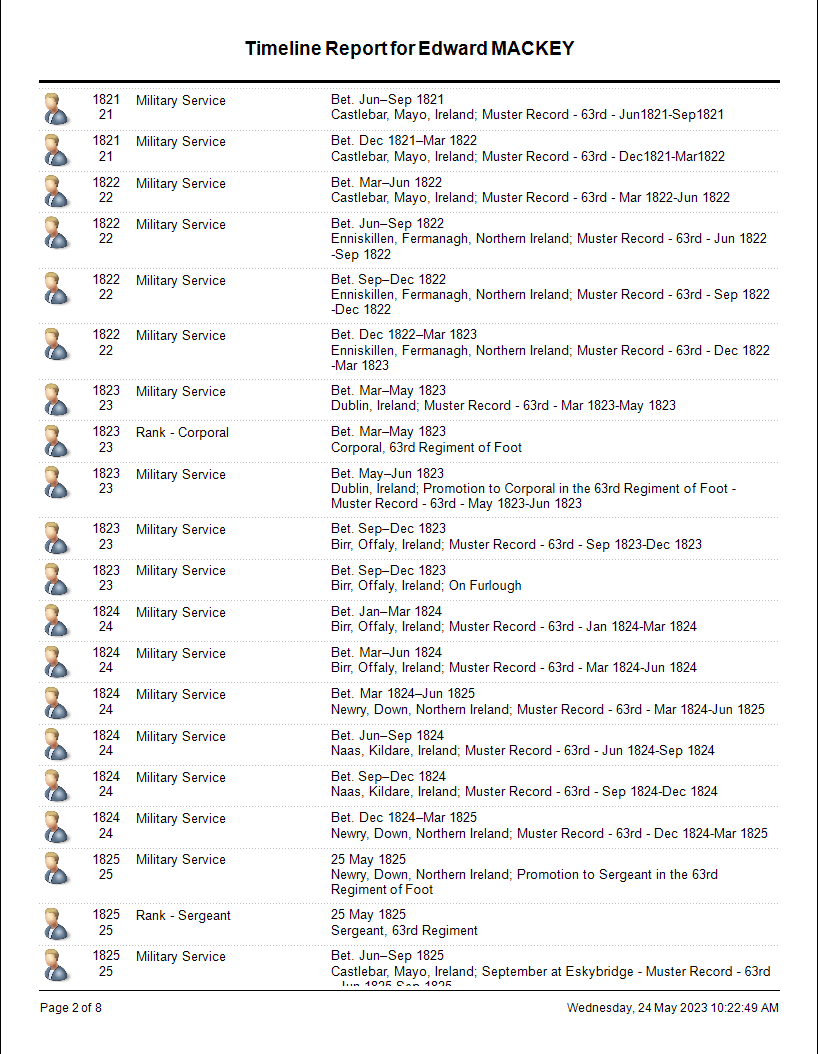
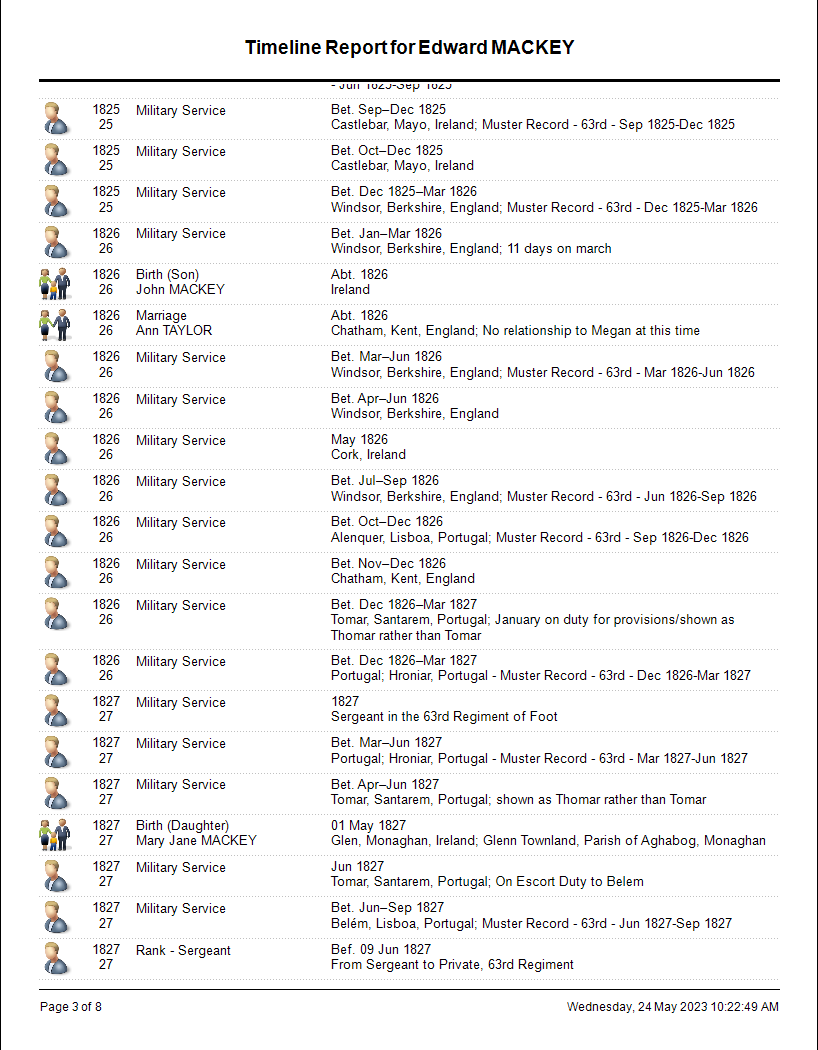
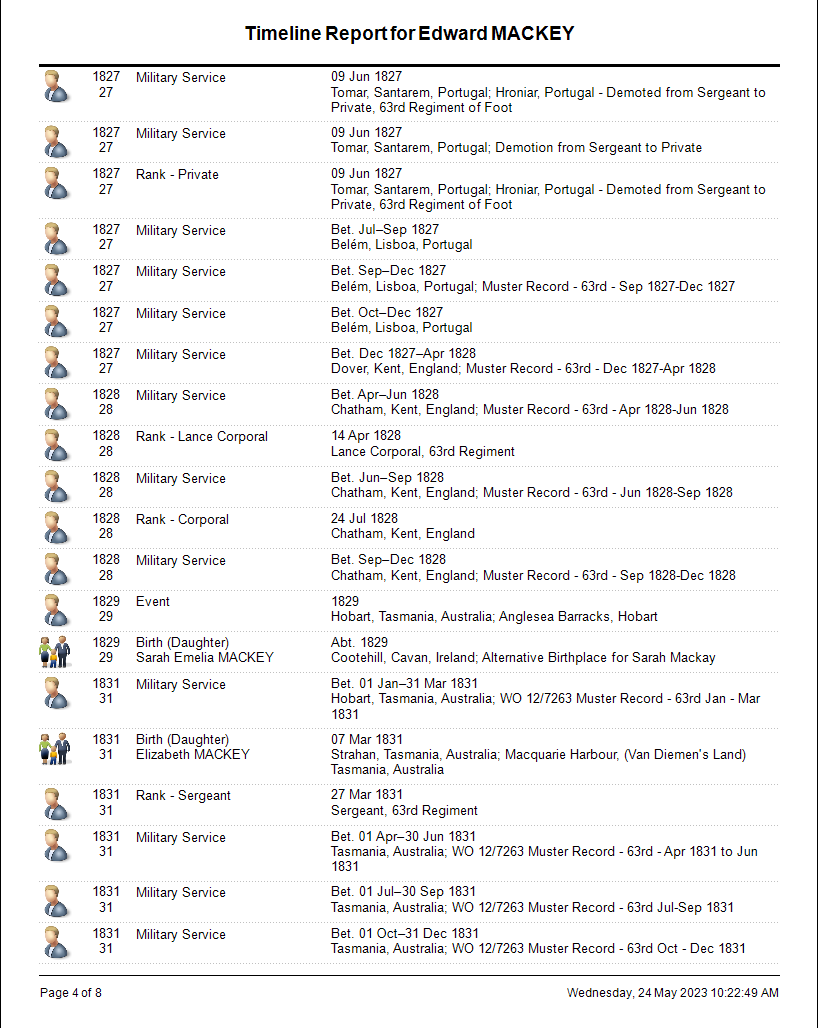
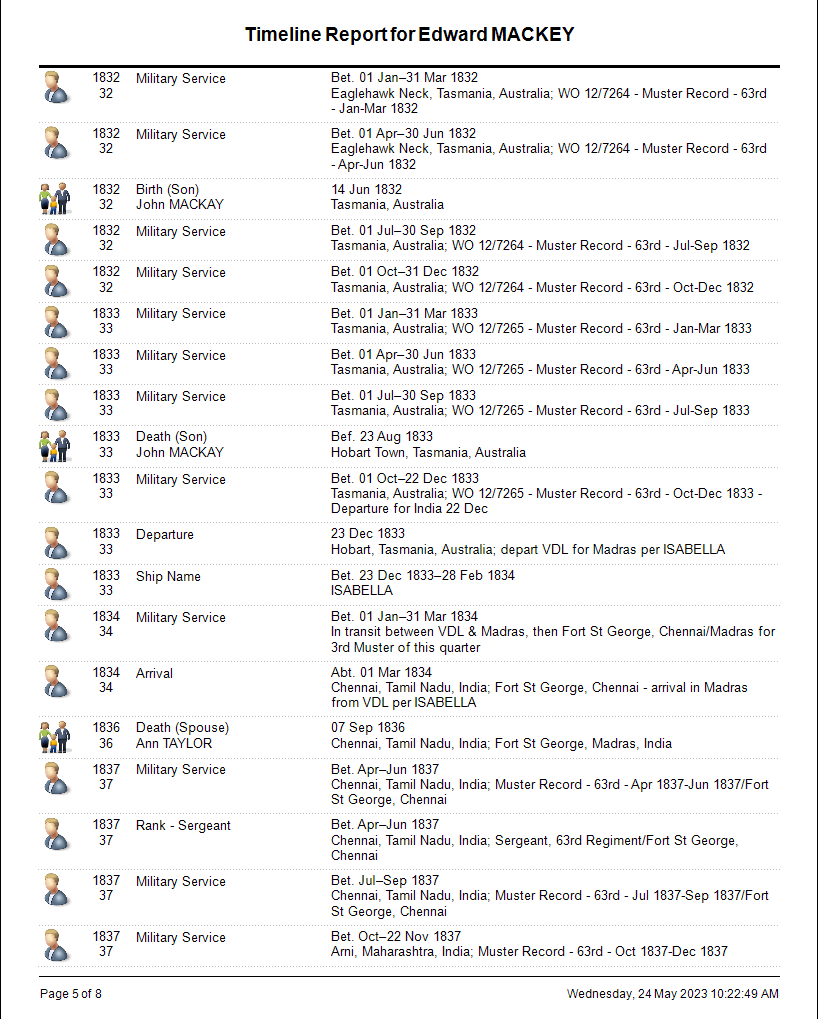
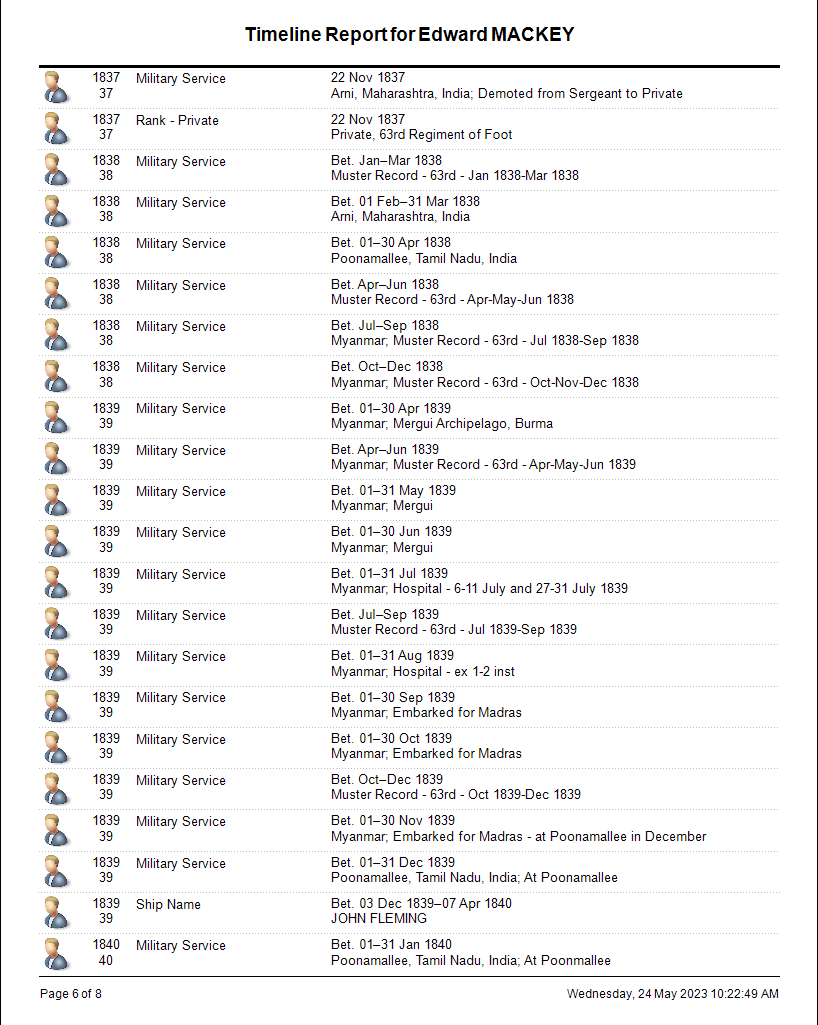
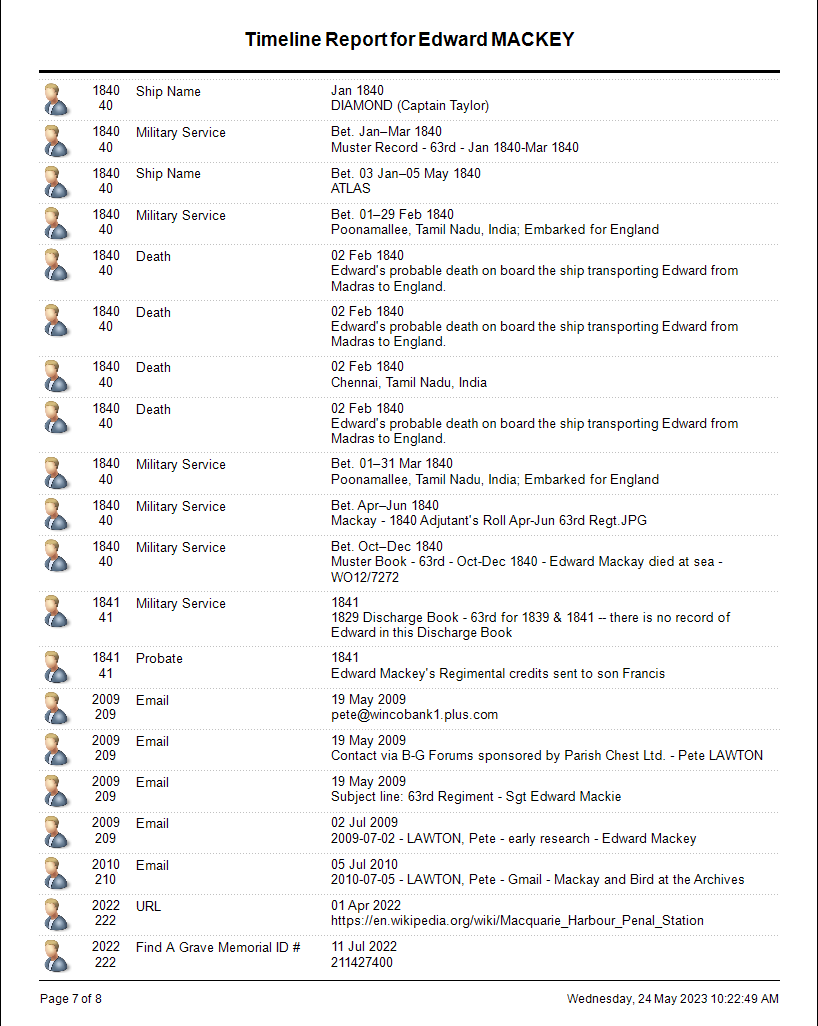
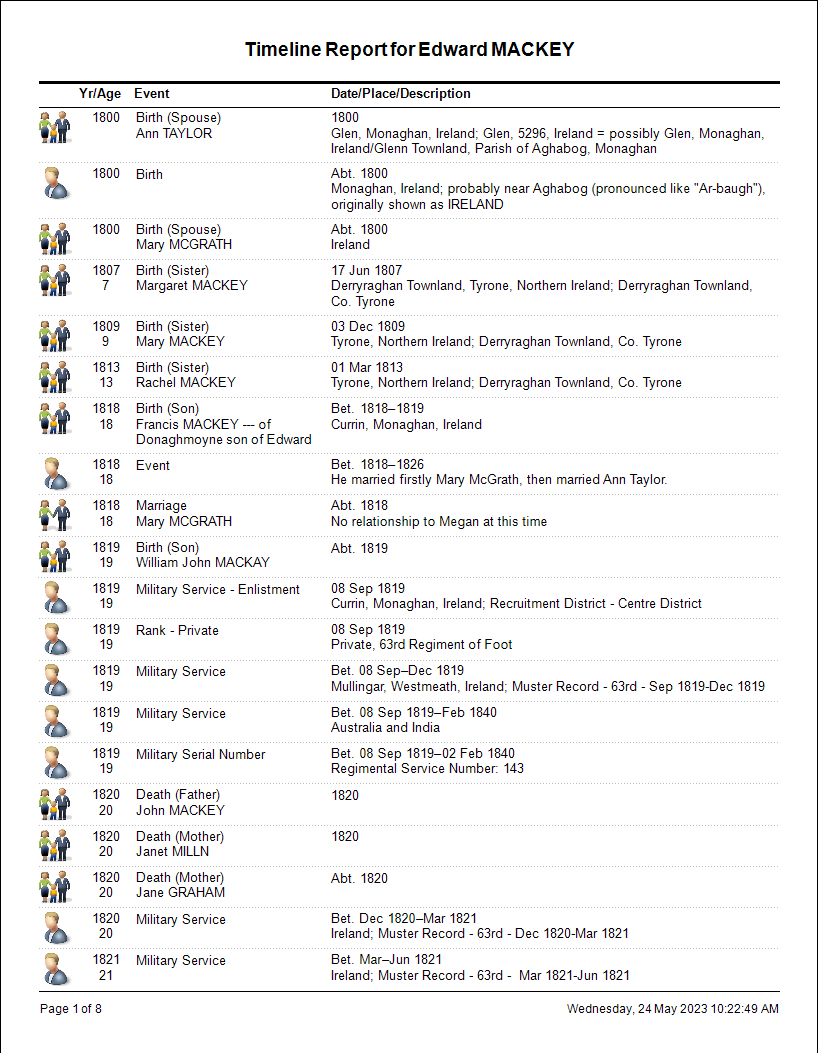
    Edward Mackey was born in County Monaghan, Ireland about 1800. Sadly, details of his parents and siblings are lacking, but the military information regarding Edward’s enlistment in the 63rd Regiment of Foot was acquired during a visit to The National Archives in Kew, in June 2016, and provides a fairly complete timeline of his military life.

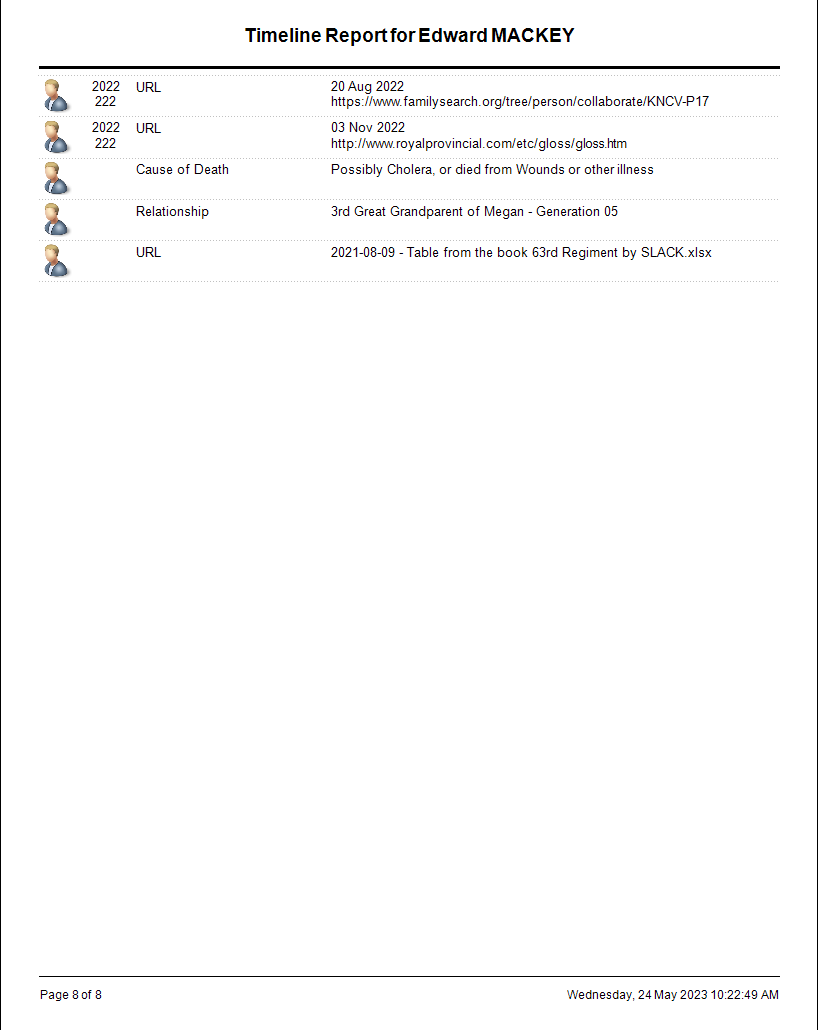
    Contrary to a number of genealogical researchers, while Edward did die at sea, he was NOT travelling between Burma to India, but rather from Madras to England. There are three possible transports, and the hypothesis is that the ATLAS is the most probable transport as it covers Edward’s reported death date of 2 February 1840.

  • Various references to Dr Westby Walker of Sofala

    1. New South Wales Government Gazette (Sydney, NSW : 1832 – 1900), Friday 3 September 1875 (No.236), page 2719

    In the Supreme Court of New South Wales.

    ECCLESIASTICAL JURISDICTION. [Bertha Sarah Walker]

    In the goods of Westby Walker, late of Sofala, in the Colony of New South Wales, surgeon, deceased, intestate.

    NOTICE is hereby given, that after the expiration of fourteen days from the publication hereof, application will be made to this Honorable Court, in its Ecclesiastical Jurisdiction, that letters of administration of the goods, chattels, credits, and effects of the abovenamed deceased, may be granted to Bertha Sarah Walker, in the Colony aforesaid, the widow and next of kin of the said deceased.—Dated this 1st day of September, A.D. 1875.

    HENRY DRIVER,

    Proctor for the Applicant, Bathurst.

    4676 6s. 6d.

    https://trove.nla.gov.au/newspaper/article/223584195?searchTerm=westby%20walker#

    2. Toowoomba Chronicle and Queensland Advertiser (Qld. : 1861 – 1875), Wednesday 9 January 1867, page 3

    DREADFUL TRAGEDY AT SOFALA.

    ( Correspondence of the Bathurst Times.)

    On Christmas Eve, about 10 o’clock, our usually quiet town was thrown into a state of excitement, by the report that murder and suicide had been committed by a man, by cutting his wife’s and his own throat. The report only proved to be too true, and a more ghastly and revolting sight could not be imagined than the one that met the eyes of the people running to the spot, where a man lay in the road with his throat cut from ear to ear, and, in a house close by, a woman in a similar state. A magisterial enquiry was held yesterday morning, by H. Bridson, Esq., P.M., when the following particulars were ascertained: — A man named Robert Corff had some disagreement with his wife and her parents, and, by the advice and interference of the latter, the wife refused to live with the husband, but both were nevertheless in the habit of meeting, occasionally, on the bank of the river, near the residence of the wife’s parents. On Christmas Eve Robert Corff was seen sitting with his wife, near the house, when the cries of the baby, that was with the mother, were heard by a younger brother of the wife, who, coming to the spot, discovered Mary Corff lying on her side, with her throat cut, and Robert Corff on his hands and knees The boy immediately made known what he had seen, and the poor woman was removed to her parent’s house, where both Dr. Hinton and Dr. Walker were in immediate attendance, but both doctors declared the case hopeless, and the poor woman died within the hour. Sergeant Casey found the man lying dead in the road, with his throat cut from ear to ear and a razor in his hand. It is most extraordinary how such a deed could be committed within a few yards of a public-house, stores, and private residences in the town, on such an evening, when so many people were walking about, without drawing the attention of some people near the spot. 

    Since the above was in type, we have received a copy of the evidence taken at the magisterial inquiry, which we subjoin : — «John M’Guiness, junior, being duly sworn, said: I am son of John M’Guiness, of Sofala. I have seen the body now lying in the old lock-up. I identify it as the body of Robert Corff,’ who was married to my sister Mary. I saw the deceased alive last night, about 10 , o’cLock; he was talking to his wife, my sister. I was standing with my mother at our own door.; They were on the bank of the river, near Anderson’s public-house, and distant from our house about thirty yards. I heard mother say to my sister, ” Mary, are you coming home —it is bed-time ?” My sister said, ” Yes, mother.” In a few minutes’ time I heard the little boy my sister had with her scream, and mother said to me, “Run down, John, here is Robert beating Mary.” I ran down at once, and found my sister lying on her side, j I saw that her throat was cut, and that blood was running out of the wound. The deceased was on his hands and knees; his throat was also cut, and I saw the blood pouring out of his neck. He had an open razor in his right hand. My sister’s baby was lying under the deceased, and was covered with blood. I picked it up, and called out, “Mother, Bob has cut Mary’s throat and his own too.” I ran away, and gave the child to somebody, and then went for the police. I knew that my sister and deceased were not living happily together. 

    John Myers, being duly sworn, said as follows: I am in the employ of Mr. Smeed, at the Two Mile Creek. I have seen the body in the old lock up. I identify it as the body of Robert Corff, who was also in Mr. Smeed’s employ. Yesterday deceased and I were working at haymaking together. Deceased went to his dinner about noon, and did not return to his work until 4 o’clock in the after-noon. I said to him, ” Where have you been, Bob?” He said, ” Writing.” Deceased came in with me from the Two Mile Creek to Sofala last night about 8 o’clock, lie changed a cheque for £1 at Mrs. Flynn’s public-house. We had two nobblers together. About half-past 8 or 9 o’clock deceased said, ” I have an appointment to meet my wife; I must go.” Ho was then quite sober. When he was going away he said, ” If I could get my wife to come down and have a dance, I should be a happy man.” On the way, coming in from the Two Mile Creek, deceased said to me that last Saturday night his wife had refused to wash a shirt for hirn. He seemed very much put out about it, but said he did not blame iior so much as he did the old people, her parents. 

    Walter Cassels Casey, being sworn, said: I am a sergeant in the police force stationed at Sofala. Last night, about 10 o’clock, I was on duty in the town. I was standing at the corner of Denison and Davis street?. I saw a disturbance in the direction of Anderson’s public-house. I at once went over. As I passed some one said, ” Sergeant, there has been murder committed on the river.” As I went down the back of the river, I met Mr. and Mrs. McGuinnoss, and another man carrying a woman whose clothes were covered with blood. Mrs. McGuiness said, ” Oh, he has murdered my poor girl.” I said, ” Where is he?” She answered, “In the river.” I went down to the river, and found deceased lying on his back. He had a razor open in his hand. His head was nearly out off, and blood was running from the wound in spurts. I put my hand under his shirt, and felt his heart beat several times. He died almost immediately. The distance from where I was standing to where I found the deceased, is not over forty yards. I at once sent for a surgeon, and left the body in charge of constable McLoay. I went over to Mr. McGuincss’s house, where I saw Mrs. Corff lying on the floor. Her throat was cut, and I heard Dr. Walker say she could not recover. I had the body of the deceased man removed to the lock-up. On searching the pockets, I found the letter I now produce, addressed to Mr. Walford, Sofala. I took it to Mr. Walford, who told me to open and read it. I did so. 

    I now produce the letter: — ” To Mr Walford, Sofala. ” 24th December, 18GG. ” Dear Sir, — I have come to the conclusion to depart this life, as my cruel wife will live with me no more, and I cannot live without her, she is my life, my light. I took my dirty shirt to her to get it washed. She told me she could not wash it, so then I said ‘ Oh ! the old people have been putting something in your head’— no answer — ‘ Well then/ said I, ‘ take it and mend the sleeve, and I will wash it myself.’ She said she could not, so I throwed it at her. She told me to come to her no more, but to send my money by anybody. Well, it grieved me to the heart. I then said; My dear, I will come to-morrow night and bring you a cheque for one pound for the last time.’ I kept my cheque from her to see how things would go. Oh my God ! Look down on my poor little innocent children 1 My wife told me she would go – to service, as the old people would keep the children. I said, ‘ You shan’t go.’ She says, ‘ I will, and you cannot stop me.’ So I thought I would stop her. It is her parents’ doing, and so they must abide by the consequences. God bless my children and keep them from all danger, and never let them know what became of their parents. Mr. Walford, be kind enough, dear sir, to put my children in the Orphan School, and lay me and my dear wife side by side. I love her, I adore her, I care for nothing but her, and I cannot leave her with that bad woman. O ! good Lord have mercy on our poor souls, as we have passed our days in Thy fear, so I hope we may end them in Thy favour, and rejoice with Thee forever in Thy Heavenly Kingdom through Jesus Christ our Lord and only Saviour, who with Thee and the Holy Ghost liveth and reigneth One God world without end. Amen. Farewell! Farewell forever; Farewell !

    “Robert and. Mary Corff”

    I also found a razor case in the trousers pocket. I produce the razor I found in de ceased’s band. It is covered with blood. On the handle is scratched ” R. Corff.” 

    Westby Walker, on oath, said: I am a duly qualified medical practitioner, residing at Sofala. Last night I was called on by sergeant Casey, to see the body of a man lying on the road near Anderson’s public-house. I have seen the body now in the old lock-up. It is the same. I have made a careful examination of the body. I find that the throat has been cut almost from ear to ear. AU the principal blood vessels have been divided; also the windpipe is cut through in two places. I believe there have been three cuts made. Such a wound would cause death in two or three minutes. From the evidence I have heard, and also from the direction of the wounds, I am of opinion that it has been a case of the most determined suicide. Somewhat similar evidence was given at the inquiry of the body of Mary Corff, aged 19 years.

    https://trove.nla.gov.au/newspaper/article/212783182?searchTerm=westby%20walker#

    3. Sydney Morning Herald (NSW : 1842 – 1954), Saturday 11 April 1863, page 6

    ADELAIDE.

    Friday, 7 p.m.

    Sofala.-At the quarterly meeting of the New South Wales Medical Board, held in the Committee Room of the Sydney Infirmary, on Tuesday, April 7th, Mr, Westby Walker, surgeon, Sofala, Turon River, was admitted as a legally qualified medical practitioner.

    https://trove.nla.gov.au/newspaper/article/13076910?searchTerm=westby%20walker#

    4. Sydney Morning Herald (NSW : 1842 – 1954), Friday 3 September 1875, page 7

    Recent Death of Dr Westby Walker

    SOFALA.-The recent death is announced, at Sofala, of Dr. Westby Walker, who had been suffering more or less, for about two years from the effects of an accident. Deceased was medical officer to the Oddfellows, and was returning from the lodge, about three months since, when he was taken seriously ill. He rallied a little, but was seized with a fit a fortnight ago while attending an inquest. He was attended professionally by his neighbour, Dr. Hinton. His death took place on the 28th of August. He was buried the following after-noon, and his funeral was largely attended, the Oddfellows marching in procession to the grave. The service was read by Brother the Rev. W. Coombes, who preached an im-pressive sermon in the evening from 2 Corinthians v. 1 to 5.

    https://trove.nla.gov.au/newspaper/article/13360000?searchTerm=westby%20walker#

    5. Sydney Mail (NSW : 1860 – 1871), Saturday 16 February 1867, page 9

    CAN THE ORANGE BE CULTIVATED IN THE WESTERN DISTRICT?

    [FROM A CORRESPONDENT.]

    Some time ago there appeared a paragraph in the Bathurst Free Press on the culture of the orange tree in the Western district, pointing out Brucedale (a few miles from Bathurst), the seat of hlr. W. H. Suttor, where the curious might have the opportunity of feasting on the orange trees in full foliage, of a healthy green, and growing very luxuriantly, Mr. Suttor also expressing confidence of their yielding fruit at the usual age at which orange trees generally bear, —when about eight years old. We are now in a position to appease the most sceptical on that point, as we are informed by Dr. Walker, of Sofala, on the Turon River, that he has one orange tree luxuriantly growing in his garden immediately behind the house. The tree stands in an eastern aspect and is about seven (7) feet high, its branches spreading nearly two yards around it; it is at present in full bearing; the oranges beginning to ripen and turn yellow, and are of a fair average size; the tree cannot have less than 150 full grown oranges upon it. When in bloom it was really a show, and some hundreds of oranges must have formed and fallen off when about the size of marbles, owing most probably to its infancy and the very long drought. This year the tree is (8) eight years old, and last year had (5) five full-grown oranges upon it, fully ripened. This season most of the inhabitants on the Turon, as well as strangers from a distance, have inspected the orange tree, and some of the most sceptical must now confess that tropical vegetation may be acclimatised to the. Western district. It is now six years since the orange trees (half a dozen in number), along with some lemons, were planted {two years old) from Mr. Shepherd’s Darling Nursery, Sydney ; they are all in a very healthy condition, and bloomed well, and some fruit also formed, but fell off during the very long drought. Sofala, February 14th.

    https://trove.nla.gov.au/newspaper/article/166804661?searchTerm=westby%20walker#

    6. Lithgow Mercury (NSW : 1898 – 1954), Wednesday 14 July 1937, page 4

    GOLD-DIGGING DAYS – BACK TO OLD SOFALA

    (By WILL CARTER.)

    Said young Sofala Present unto old Sofala Past, 

    Whose eyes had still a sparkle, and whose thoughts were backward 

    Come, walk with me, and talk to me, of old familiar ways,

    And of places, and of peoples who lived; in the early days

    Come, point me out a cottage where so-and-so was born, 

    And tell of jovial diggers who have rolled their swags and gone. 

    The rambling street was full of inns, they say, in days of yore, 

    What wasn’t then a public-house was bound to be a store. 

    Old timbers still are standing; and monuments of stone, 

    And scattered bricks have stories of an interest all their own. 

    And you’ll awaken echoes in telling this and that, 

    Of “George the Snob,” “The Jingler,” and “Mick of Monday Flat.”

    (Copyright.) No. 10.

    A BIT OF STRIPPING ‘ In alluvial mining there is often a considerable amount of stripping to be done, in order to facilitate the’ treatment of the gold-bearing wash-dirt; the deeper the ground, the greater the body of overburden to be removed, of course. When dealing with, a particular period of time in the course of a town’s history, the process is somewhat the same, though, in the latter sense, the stripping off is of years, instead of merely feet of clay. Let us then begin stripping at the surface level of 1936. By removing 56 years we reach the 1880 stratum of Sofala. Let us now strip off, say, 20 more years, and we reach the Old Sofala period of 1860. Now, away with nine more years and we reach Oldest Sofala, and the currency of events commencing in 1851. The process responds actually to the experience of mining operation: the gold goes down, the nearer the rock ; the richer the deposit. We have thus stripped off 85 years, and reached the richest stratum of all. Chronologically, then, Oldest Sofala extends from 1851 to I860, Old Sofala from 1860 to 1880, and Sofala thenceforward to the present time.

    CONSTANT CHANGE. Change is always producing its effect in. the disposition of business in a township, be it old or recent. There is mostly’ someone— a grocer,’ baker, butcher, tailor, or chemist disposing of his business to another; a stranger to the town, very often, who replaces him in the street. For this reason, it is inevitable that when a writer comes along to tell, in after years, who lived here, who kept a grocery there, or ran a hotel business somewhere else in the town, at a certain period, he is almost sure to find some critic arise to point out what ho deems to be an error.: He frequently writes to the paper responsible, for the published ‘ statement to enlighten the editor thusly: “It wasn’t Grimes who had a grocery shop in Blank-street, it was a man by the name of Jones.” As a matter of fact, Grimes, Jones, Brown and Robinson had all conducted. a grocery in. the same premises; at different times, and the critic had only known of Jones. A recorder writes of who- was who, and where, at a certain period with which he has familiarised himself, as I am about to do with regard to Denison-street, Old Sofala, sometime in- the sixties.

    THE MAIN STREET IN THE SIXTIES The great gold rush in 1851 furnished Sofala with a considerable population in a very short space of time. Miners acquired a small residential allotment of land by virtue of their miner’s rights, and down they settled in tent or hut, some to shift off ere long, and make way. for others, and the rest to remain and extend their holdings. Town-planning had not concerned men’s minds, surveys and alignment of streets were dispensed with in the hurry, and so the old town, like Topsy, just “growed.” That streets straggled somewhat crookedly, and that obscure by-lanes served in places of cross-streets, was only a natural consequence. On coming from Wattle Flat one entered Denison-street, the main thoroughfare, at the foot of the hill. On the right side stood Anderson’s public-house, the next place being a store kept by Maxwell. Then came Walford, who was in a big way of business. He was general storekeeper, sold wines and spirits, and bought gold extensively. Chisholm’s store was next, with reserve premises almost adjoining, in which lie kept produce and sundries. Nearby stood Jack White’s fruit shop and confectionery, with Williams’ hotel below. Further down one came to a public-house run by George Morrison, known as “George the Snob,” handy with his fists, and whose billiard-marker was “Black” Perry, a noted champion of the ring. Lonergan, the bootmaker, came next in order, and then the old “Barley Mow” Inn owned by Foreman, and destined with considerable extension, and under another name (The Royal) to survive all other hotels in the township. A blacksmith and farrier’s shop came next, and it was there that William Rogers, recently deceased, learned his trade under a man named Smith. Dan Martin’s store followed, and that brought one to Dr. Walker’s premises. Lower down there was a Chinese store, kept by Ah Son, and the next place was Hennessy’s bakery, whose owner was killed later by a kick from one of his horses. Then came private homes occupied by Messrs. Webster, Williamson (“Sam the Jingler”), Monteith McCloy and Charles Brooks. Stacey, the carpenter, lived next door, with three stores below, kept by Cummings, Patterson and Southcott. A little down from there lived “Brummy” Griffiths, with Johnny Morgan next door. Swain’s hotel was the last’ refreshment house on that side of the street, and Riley’s store was below that again. Retracing one’s steps along the old street, a tannery was noticed across the Turon River, and kept then by a I man named Pickering, a son of the Rev. Pickering, a Methodist minister of Sofala. That ancient Tannery’s demand for wattle bark robbed Wattle Flat of a deal of its golden (wattle) glory. Now, starting down the street again for an inspection of the left-side premises, we. found Chisholm’s saddlery, and then James Fulton’s fine store. A bootmaker named Harland had a small shop below, and later built a fine two-storey brick building, the first -brick premises erected at Sofala. In time, that passed into the possession of James Fulton, who let the place to the Bank of. N.S.W., and when it closed its doors, the City Bank occupied the building. Jim Tilling’s public-house came next, then Alfred Taylor’s saddlery, and a store kept by. Mrs.Cole. . A narrow by-lane and then O’Connor’s store, with Pout’s place below, succeeded by William Taylor’s general store, separated from Keegan’s store by some private houses, one of which was occupied by Smith, a blacksmith. One of the earliest hostelries of Sofala was kept by John Williams, and below stood the old wooden post-offlce, kept then by Postmaster Smith; Another little laneway, and one reached William Beecham’s’ shop, which was burnt down later. Below that was a yard which Hennessy the baker used for his horses. A little below, where at Bowen-street intersected obliquely lived Billy Moloney, the coach-driver at that time, and just across was Dr. Hinton’s pharmacy, and then Mrs Willett’s Inn. Farther down, on the left side, stood the “Dublin Tavern, kept by McLean for many years, at no great distance from Swain’s, which was on the other side of the street. It was not a very elegant thoroughfare, the same old Denison-street. It was not as wide as Macquarie-street, in Sydney, its buildings were not imposing, nor distinguished for their architectural beauty, but it is very probable that more gold was converted into cash there, and more cash put into circulation along its course in the first 20 years of gold-getting on the famous old field, than in any other mining town in the State. This brief survey is merely confined to the main street and its business in the sixties. Walford’s was, perhaps, the most conspicuous place of business, and was run on wholesale as well as retail lines. Most of the inns purchased their spirits from him. Fulton was a genuine friend and backer, ever ready to keep a digger going at his prospecting operations, where he saw the man was deserving of help. He was first in business at Wallaby Rocks, later acquiring the Sofala business from his brother William, who left for other parts. There is a story told of Prosper’s nugget, and how it came to be found, which was bearing on the subject of business-backing. Prosper had been kept going with supplies for months by Fulton. His luck was dead out, like that of Skewes, previously commented upon. He was working up at Redbank at the time and at last Fulton’ had to tell him that he could only grant him another week’s supplies. Before the week had passed. Prosper turned up with a splendid nugget worth hundreds of pounds. Fulton made him an advance, after squaring his account, and Prosper sold the nugget at the bank next day, and in this way Prosper became prosperous, but he never forgot Fulton and the faith he so Iong reposed in him.

    https://trove.nla.gov.au/newspaper/article/221865565?searchTerm=westby%20walker#

    7. North Western Courier (Narrabri, NSW : 1913 – 1955), Thursday 26 May 1927, page 5

    OBITUARY

    MRS. ROBERT HARDY  [Elizabeth nee Comber]

    The death occurred on May 21st, of Mrs. Robert Hardy, an old and highly respected resident of the Nar-abri district. Deceased came on the Namoi in the early seventies, where her husband had taken up land, which waa afterwards known as

    “Mollie View”, and he later acquired Bell’s Mount, near Barraba, and Largreen, in the Warialda district. Her early life was spent on the famous Turon diggings, where she lived with her aunt, whose husband, Dr. Walker, was Government medical officer. She had vivid recollections of the excitement of eager selectors for gold and the starting each month of the gold escort, surrounded by mounted troopers. J. W. Mackay, known in America as ‘The Silver King,’ who died in 1902, was also an uncle. The late Mrs. Hardy leaves a family of three sons and five daughters. They are: Percy (Narrabri), Arthur (Scone), Andrew (Queensland), Mrs. Liferman (Paddington), Mrs. Miller (Pyrmont), Mrs. Malone (Murrurundi), and Mrs. Wall and Mrs. Rowland (Narrabri). Her husband predeceased her 20 years ago, also one daughter. 

    https://trove.nla.gov.au/newspaper/article/138352813?searchTerm=westby%20walker#

    8. Evening News (Sydney, NSW : 1869 – 1931), Thursday 15 March 1877, page 2

    Marriage

    O’HERN— WALKER —March 13, at St. Andrew’s cathedral, by the Rev. Canon O’Reilly, John Collins O’Hern, to Bertha Sarah, widow of the late Dr. Westby Walker, of Sofala. 

    https://trove.nla.gov.au/newspaper/article/108200908?searchTerm=westby%20walker#

    9. New South Wales Government Gazette (Sydney, NSW : 1832 – 1900), Tuesday 5 July 1864 (No.134), page 1518

    The Treasury, New South. Wales, 1st July, 1864

    THE undermentioned persons have been duly authorized to sell Postage Stamps from the dates set against their names respectively:—

    1864.

    13th May Mr. Westby Walker, surgeon, Sofala.

    https://trove.nla.gov.au/newspaper/article/225356809?searchTerm=westby%20walker#

    10. Sydney Morning Herald (NSW : 1842 – 1954), Thursday 15 March 1877, page 1

    MARRIAGES.

    O’HERN—WALKER.—March 12, at St. Andrew’s Cathedral, by the Rev. Canon O’Reilly, John Collins O’Hern, to Bertha Sarah, widow of the late Dr. Westby Walker, of Sofala. No cards.

    https://trove.nla.gov.au/newspaper/article/13394444?searchTerm=westby%20walker#

    11. Sydney Morning Herald (NSW : 1842 – 1954), Tuesday 14 September 1875, page 1

    DEATHS.

    WALKER.—August 28, at his residence, Sofala, Westby Walker, surgeon, aged 72 years, after a long and painful illness, which he bore with Christian fortitude, leaving a wife and large circle of friends to mourn their loss.
    https://trove.nla.gov.au/newspaper/article/13361417?searchTerm=westby%20walker#
  • Timeline for EDWARD COMBER b1820

    As previously seen, Edward COMBER, one of my 2nd Great Grand Fathers, was born around 1820 in Spitalfields/Smithfield, London to James COMBER and Elisabeth Lowe.

    https://wordpress.com/post/genimagus.wpcomstaging.com/201 https://wordpress.com/post/genimagus.wpcomstaging.com/187

    Here’s a Timeline for his life:

  • Joseph George Westby Walker “West” COMBER

    Joseph George Westby Walker “West” COMBER  was a man of many names.

    He had his birth registered in Tamworth as Joseph W COMBER on Friday, 4th April 1862, at Tambar Springs in Tamworth, New South Wales, Australia.[[i], [ii], [iii], [iv], [v], [vi][vii]]

    His parents were Edward COMBER, son of James Robert Comber and Elizabeth Lowe, who was born on 20 Dec 1820 in Spitalfields, London, England. Edward died on 31 Jul 1900 in Armidale, New South Wales, Australia (in Armidale Hospital).

    Edward married Elizabeth MACKAY on 21 Jul 1851 in Sydney, New South Wales, Australia (Parish of St Philip, Sydney, New South Wales, Australia – Banns – William Cowper). Elizabeth Mackay was the daughter of Edward Mackay and Ann Taylor, and was born on 07 Mar 1831 in Strahan, Tasmania, Australia (Macquarie Harbour, Van Diemen’s Land). She died on 18 May 1880 in Bundella, New South Wales, Australia.

    While Elizabeth was born in Van Diemen’s Land (now Tasmania), she and her sisters went through many adventures before returning to Australian shores, when Elizabeth and her sister Sarah Emilia arrived in 1850 onboard the ship JOHN KNOX as Irish Famine Orphans.

    Elizabeth married Edward, and Sarah appears to have been a partner to a man named Westby WALKER who was born in Preston, Lancashire. He was a Doctor of Medicine in Lancashire. He was known to have been the Postmaster at Sofala, at the Goldfields on the Turon River, and he eventually was recognised as a Medical Doctor in New South Wales.

    It is that relationship (that of Sarah with Westby Walker) that leads to Elizabeth and Edward naming one of their sons with a name that included “Westby Walker” in it!  There is a hypothesis in the family that Dr Westby Walker actually delivered the baby known as Joseph in the Birth Register.

    Not much is known about the childhood of Joseph, but he married Anna Maria Chilvers.

    It is a family anecdote that they were married on 14 Dec 1881 in Quirindi, New South Wales, Australia. However, there is another story that there was no marriage, and there is no registration in the NSW Registry.

    Anna Maria Chilvers was born in 1852 in Parramatta. She and Allen Hildreth were married in Mudgee on 21 Aug 1874, and there were no known children of the marriage… however, an advertisement appeared in an 1884 newspaper for “Mrs A Hildreth to contact her daughter” which may have been a ploy to get a response from her!

    This timeline fits what is known at this time:

    1. Anna Maria Chilvers marries Allen Hildreth in 1874
    2. Anna Maria and Joseph “run off” together and are ostensibly married in 1881
    3. Ellen (Nellie) born 1883
    4. Thomas Edward (Ted) born 1884
    5. The newspaper article of 1884 requesting Mrs Hildreth to contact her daughter
    6. George Westby born 1886
    7. Rosalie (Sis) born 1887
    8. James Henry (Jim) born 1889
    9. Dorothy (Dollie) born 1891
    10. John William (Jack) born 1893
    11. Lillian Elizabeth (Lovie) born 1895

    One of the names (or name changes!) for Joseph was Joseph’s adoption of the name George. Edward and Elizabeth had 14 children, one of whom was George William Comber who was born and died in 1867, only living for 8 days. There is a family story that Joseph ‘appropriated’ George’s name to honor him.

    Another name change was his use of the name Joseph Westby COMBER, which is a legitimate representation of his Registration name.[[viii]]

    However, Joseph also went by the name of Westby Wilkins COMBER.[6] This may be a mistranscription of his Registration name.

    Also used was the name Joseph George Westby Walker West. Family anecdotes say that Joseph used the nickname “West” within his family and social circles.


    Joseph is thought to have died in Coonabarabran, New South Wales, Australia, on 15th July 1945, at the age of 83.[2, [ix]] However, the parents shown in the Death Registration do not reflect Edward and Elizabeth, but rather George and Sarah.

    However, because he used so many different names, it is possible he actually died in Armidale, New South Wales, Australia, on 9th July 1946, at the age of 84, though no Death Registration has yet been found.


    Sources:

    [i]                LDS Records, ComberEdward1820.FTW.

    [ii]                Ancestry.com, “Public Member Trees [database on-line].”, Ancestry.com, Public Member Trees (Name: Ancestry.com Operations, Inc.; Location: Provo, UT, USA; Date: 2006;), www.ancestry.com.au, Database online.

    [iii]               NSW Registry of Births Deaths & Marriages, NSW – BDM Registry (GPO Box 30, SYDNEY NSW 2001, NSW Department of Justice), www.bdm.nsw.gov.au, Birth – COMBER,  JOSEPH W  – 13799/1862  – EDWARD – ELIZABETH – TAMWORTH.

    [iv]               NSW Registry of Births Deaths & Marriages, NSW – BDM Registry (GPO Box 30, SYDNEY NSW 2001, NSW Department of Justice), www.bdm.nsw.gov.au, Birth – COMBER,  GEORGE  – 8812/1867 –  EDWARD – ELIZABETH – COONABARABRAN.

    [v]                NSW Registry of Births Deaths & Marriages, NSW – BDM Registry (GPO Box 30, SYDNEY NSW 2001, NSW Department of Justice), www.bdm.nsw.gov.au, Birth – COMBER,  George  – 8812/1867  – Edward – Elizabeth – Dubbo.

    [vi]               Email Source – Horton, Lesley, Lesley knows George Westby Walker Comber as WESTBY WILKINS COMBER.    However, Lesley also refers to the fact that her grandmother, Lillian Elizabeth Comber DUCE, and her mother, Thelma, refer to him as GEORGE WESTBY WALKER COMBER.

    [vii]               Ancestry.com, Australia, Death Index, 1787-1985 (Provo, UT, USA, Ancestry.com Operations, Inc., 2010), Ancestry.com, http://www.Ancestry.com, Record for George W Comber. http://search.ancestry.com.au/cgi-bin/sse.dll?db=AusDeathIndex&h=4326452&indiv=try.

    [viii]              Studsrod, Sonia, A Genealogy Report For SONIA STUDSROD, Generation of Grandparents.

    [ix]               NSW Registry of Births Deaths & Marriages, NSW – BDM Registry (GPO Box 30, SYDNEY NSW 2001, NSW Department of Justice), www.bdm.nsw.gov.au, Death – 15961/1945  – COMBER – GEORGE WESTBY WALKER – GEORGE – SARAH – COONABARABRAN.

  • James Comber – NOT a nice man…

    I spent some more time researching my Comber family and I was saddened to find these entries in TROVE, the Australian digitised newspaper archive run by the National Library of Australia. My third great-grandfather James Robert Comber was apparently NOT a nice man.

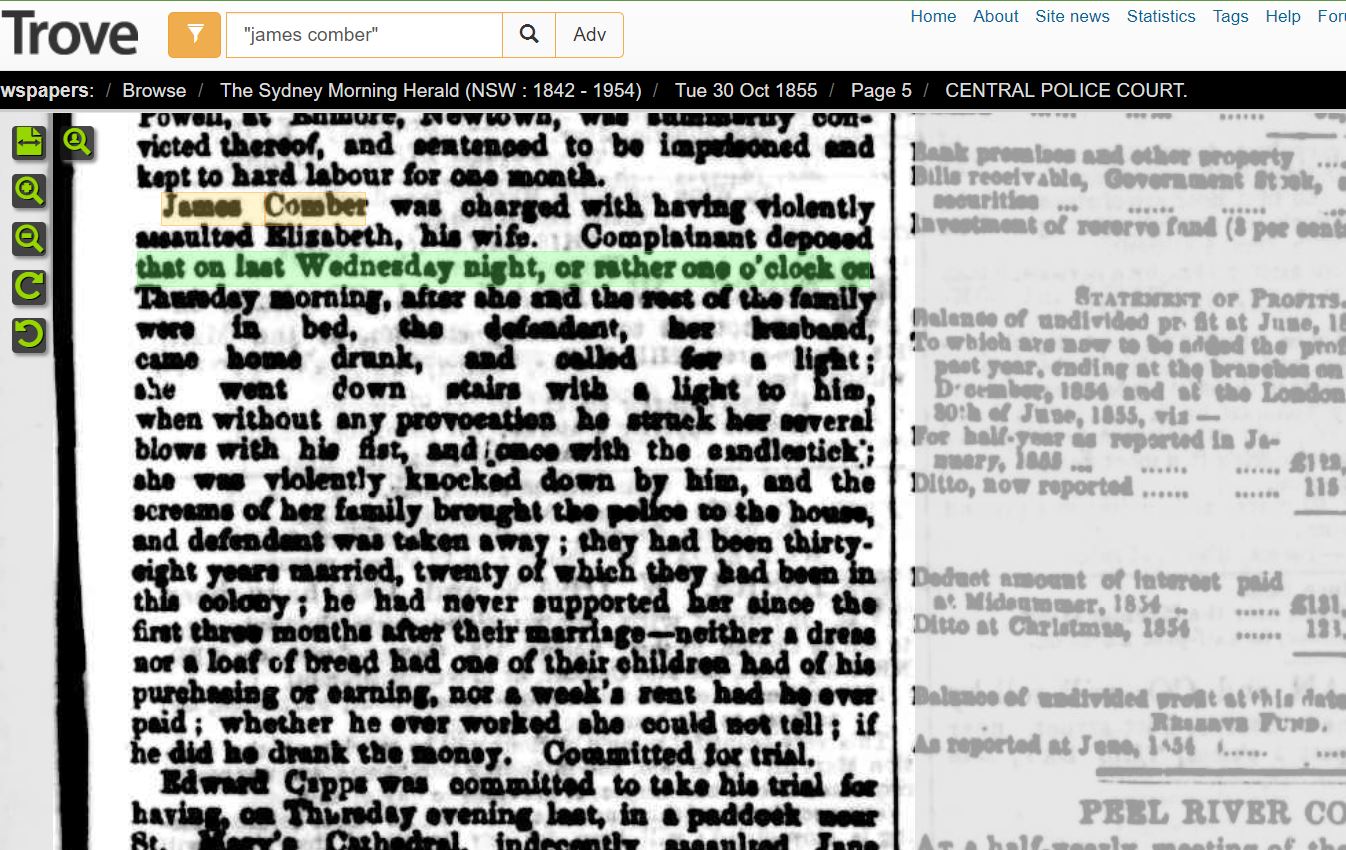
    The Sydney Morning Herald – Tues 30 Oct 1855 – Page 5 – CENTRAL POLICE COURT

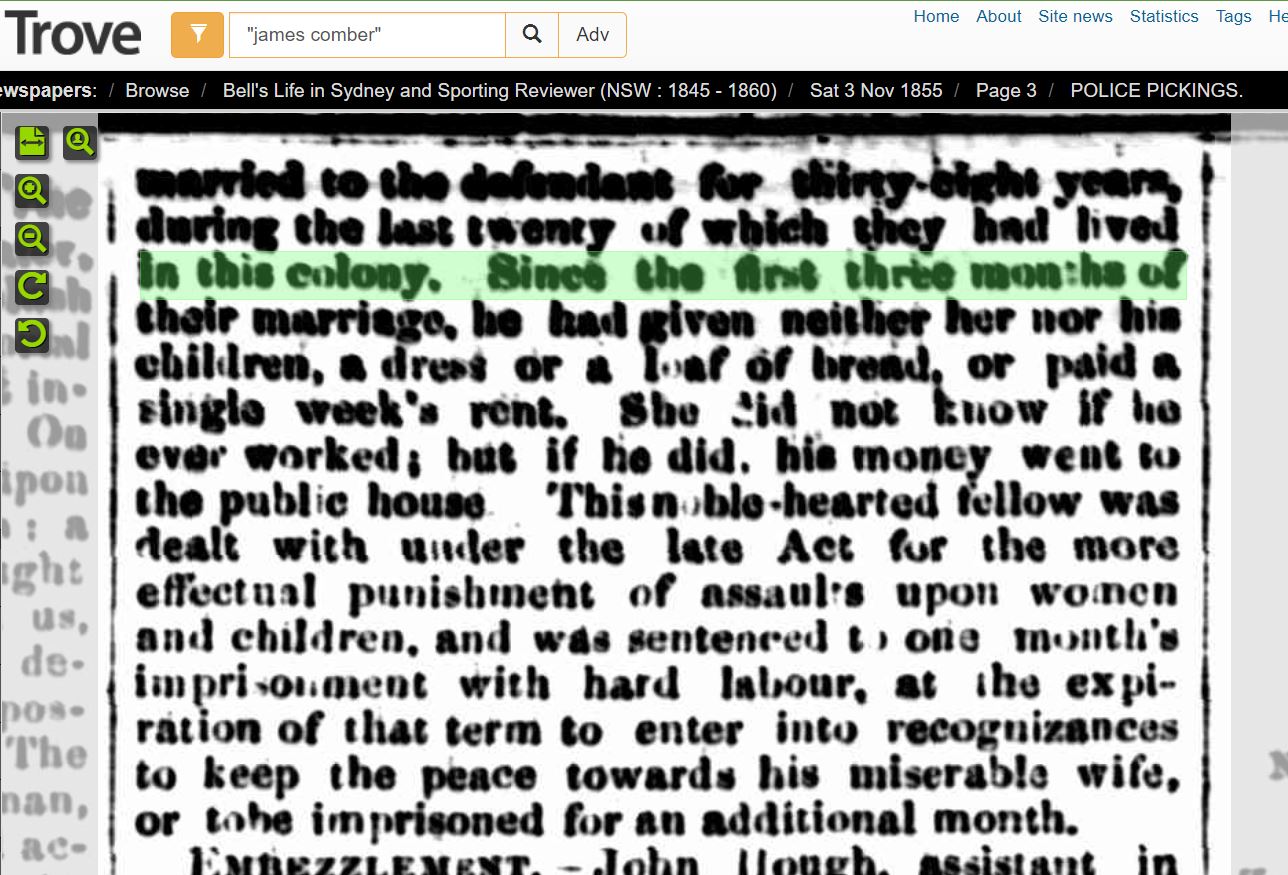
    James Comber was charged with having violently assaulted Elisabeth, his wife. Complainant deposed that on last Wednesday night, or rather one o’clock on Tuesday morning, after she and the rest of the family were in bed, the defendant, her husband, came home drunk, and called for a light; she went downstairs with a light to him, when without any provocation he struck her several blows with his fist, and once with the candlestick; she was violently knocked down by him, and the screams of her family brought the police to the house, and defendant was taken away; they had been thirty-eight years married, twenty of which they had been in the colony; he had never supported her since the first three months after their marriage – neither a dress nor a loaf of bread had one fo their children had of his purchasing or earning, nor a week’s rent had he ever paid; whether he ever worked she could not tell; if he did he drank the money. Committed for trial.

    =-=-=-=-=-=-=-=-=-=-=

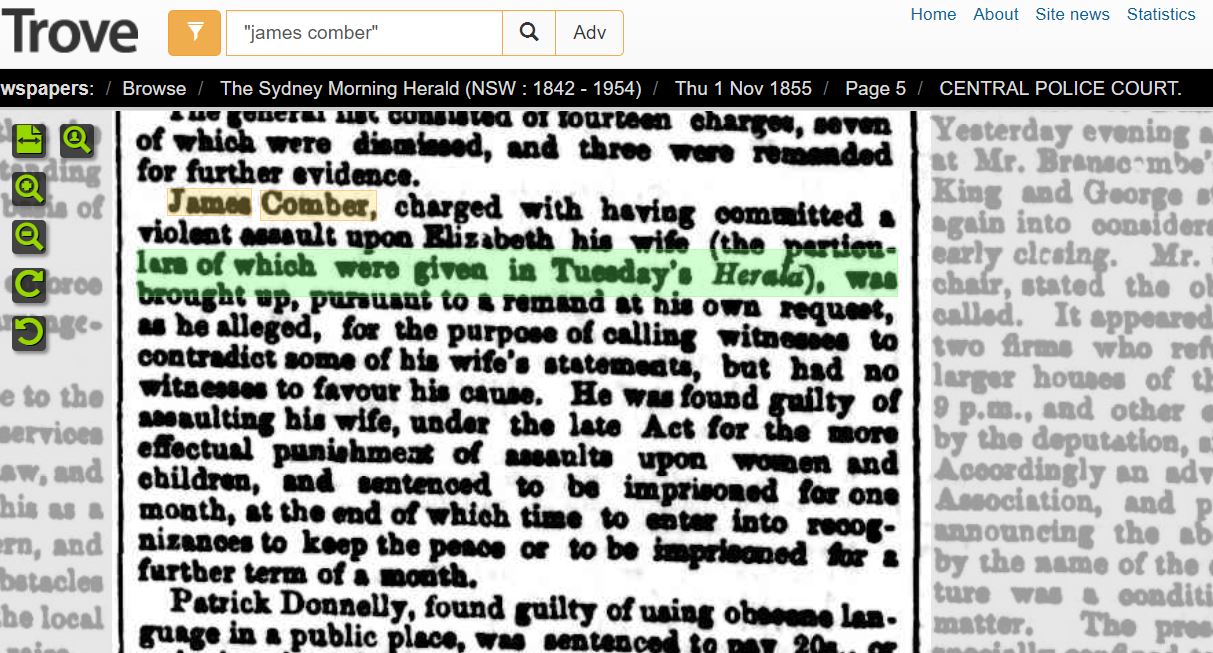
    The Sydney Morning Herald – Thurs 1 Nov 1855 – Page 5 – CENTRAL POLICE COURT

    James Comber, charged with having committed a violent assault upon Elisabeth his wife (the particulars of which were given in Tuesday’s Herald), was brought up, pursuant to a remand at his own request, as he alleged, for the purpose of calling witnesses to contradict some of his wife’s statements, but had no witnesses to favor his cause. He was found guilty of assaulting his wife, under the late Act for the more effectual punishment of assaults upon women and children, as sentenced to be imprisoned for one month, at the end of which time to enter into recognizances to keep the peace or to be imprisoned for a further term of a month.

    =-=-=-=-=-=-=-=-=-=-=

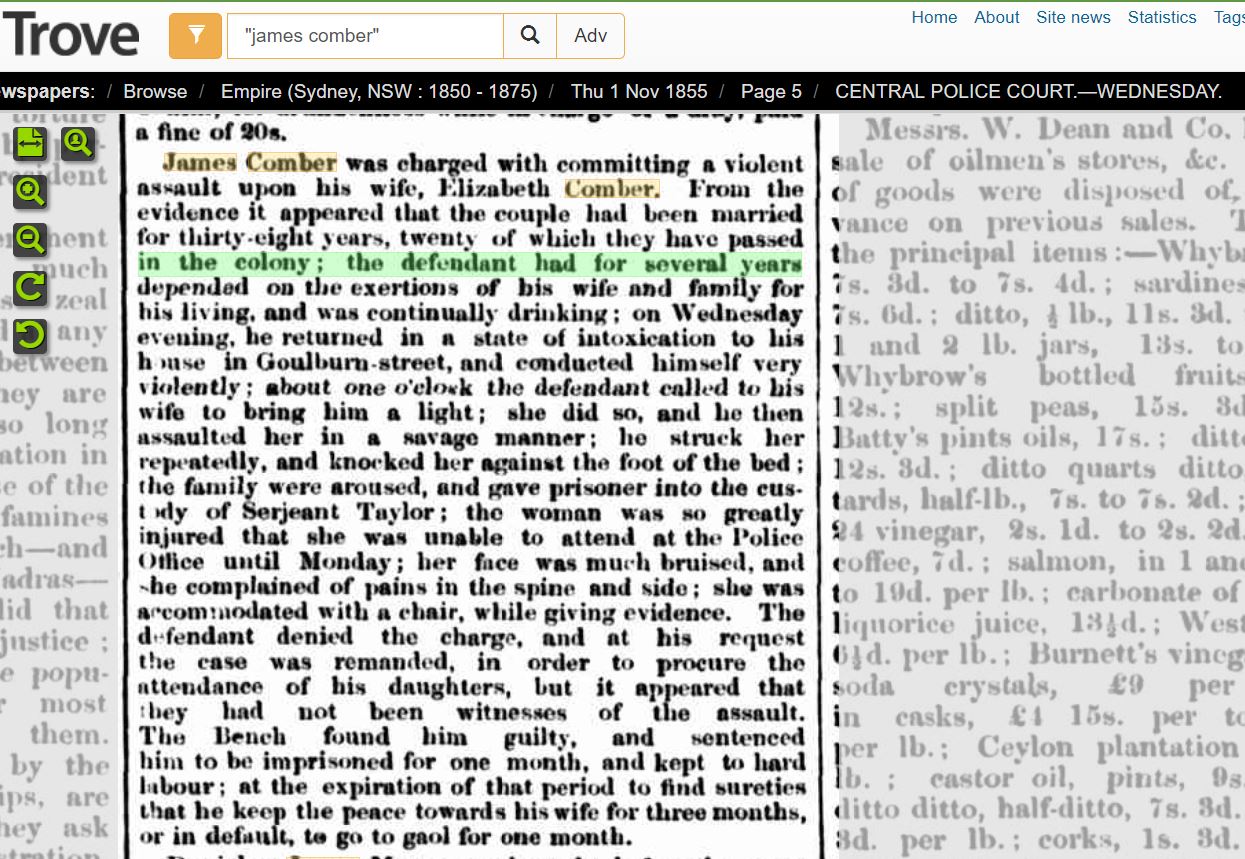
    Empire – Thurs 1 Nov 1855 – Page 5 – CENTRAL POLICE COURT – WEDNESDAY

    James Comber was charged with committing a violent assault upon his wife, Elizabeth Comber. From the evidence it appeared that the couple had been married for thirty-eight years, twenty of which they have passed in the colony’ the defendant had for several years depended on the exertions of his wife and family for his living, and was continually drinking; on Wednesday evening, he returned in a state of intoxication to his house in Goulburn-street, and conducted himself very violently; about one o’clock the defendant called to his wife to bring him a light; she did so, and he then assaulted her in a savage manner; he struck her repeatedly, and knocked her against the foot of the bed; the family were aroused, and geve prisoner into the custody of Serjeant Taylor; the woman was so greatly injured that she was unable to attend at the Police Office until Monday; her face was much bruised, and she complainedof pains in the spine and side; she was accommodated with a chair, while giving evidence. The defendant denied the charge, and at his request the case was remanded, in order to procure the attendance of his daughters, but it appeard that they had not been witnesses of the assault. The Bench found him guilty, and sentenced him to be imprisoned for one month, and kept to hard labour; at the expiration of that period to find surities that he keep the peace towards his wife for three months, or in default, to go to gaol for one month.

    =-=-=-=-=-=-=-=-=-=-=

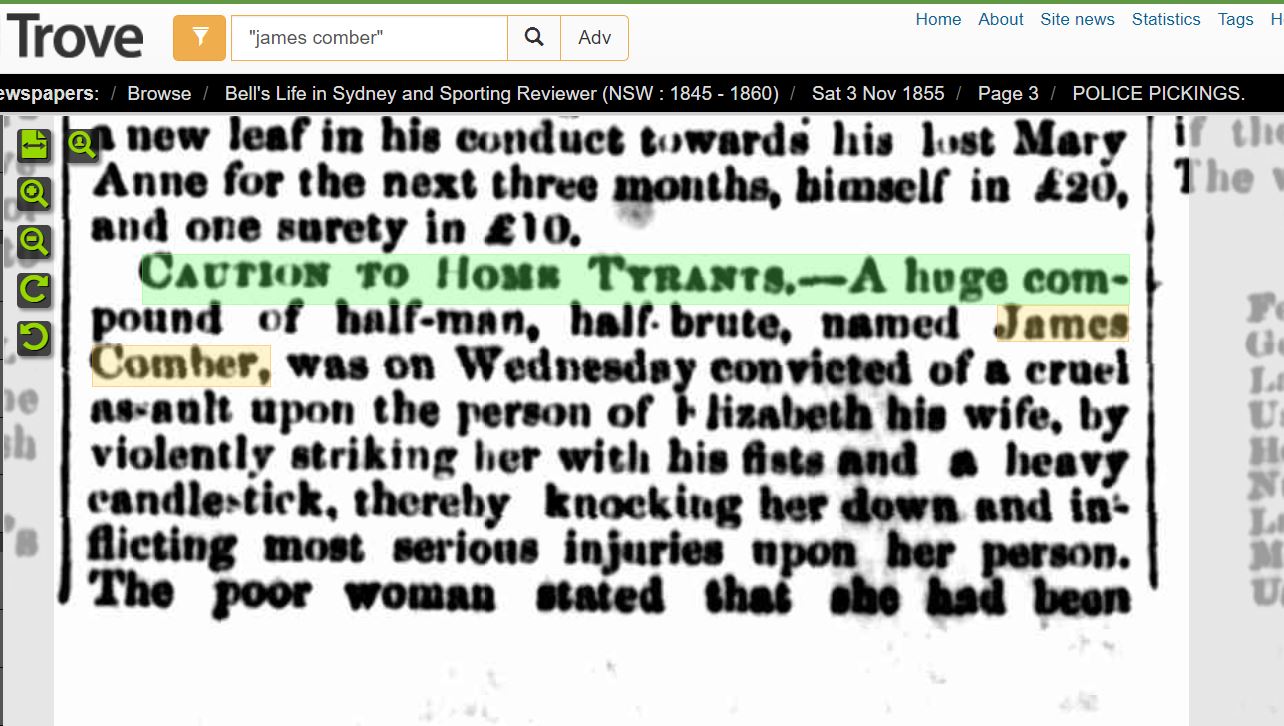
    Bell’s Life in Sydney and Sporting Reviewer – Sat 3 Nov 1855 – Page 3 – POLICE PICKINGS

    Caution to Home Tyrants – a huge compound of half-man, half-brute, named James Comber, was on Wednesday convicted of a cruel assault upon the person of Elizabeth his wife, by violently striking her with his fists and a heavy candlestick, thereby knocking her down and inflicting most serious injuries upon her person. The poor woman stated that she had been married to the defendant for thirty-eight years, during the last twenty of which they had lived in this colony. Since the first three months of their marriage, he had given neither her nor his children, a dress or a loaf of bread, or paid a single week’s rent. She did not know if he ever worked; but if he did, his money went to the public-house. This noble-hearted fellow was dealt with under the late Act for the more effectual punishment of assaults upon women and children, and was sentenced to one month’s imprisonment with hard labour, at the expiration of that term to enter into recognizances to keep the peace towards his miserable wife, or to be imprisoned for an additional month.

    =-=-=-=-=-=-=-=-=-=-=

    James was born about 1796-1798 (based on the NSW Gaol Description and Entry Books in 1845 and 1849), in England. He and wife Elisabeth married in 1815 at St Luke’s Finsbury. Ostensibly a Silk Weaver, there were two stints in the Workhouse for Elisabeth and the children until James enlisted in the 50th Regiment of Foot at the age of 30 on 24 Feb 1826. The Regiment served in Ireland and acted as Convict guards on transport ships to NSW. James, Elisabeth and their family arrived in NSW in 1834 on the ship BLENHEIM. James was discharged from the Regiment on 31 May 1836 while stationed in Windsor, NSW. Besides the mention of James in the Gaol Description books and an announcement of daughter Matilda’s marriage in 1863, there is no sign of James or of his death.

  • Back to the Comber Family

    I had a great success today – I found the Death Notice for my 3rd Great Grandmother, Elisabeth (Lowe) Comber!

    She has been what is known as an “elusive lady”… I have her marriage to James Comber (also Coomber) in 1815 at St Luke’s Finsbury, and I have the baptismal registrations for

    • James Robert in 1818 in Shoreditch, London
    • Ann in 1827 in Northampton, Northamptonshire
    • Matilda in 1837 in Australia

    In these 4 documents, she is referred to as “Elisabeth” – just Elisabeth.

    And also, her name is interchangeable with the more frequent spelling of “Elizabeth”.

    Using Trove, the National Library of Australia’s Digitised Newspaper site, I happened to plonk in “Comber” and “Coomber” in the same search field, and a date after the last mention of her in a Police Report against her husband James (1858). And there she was!

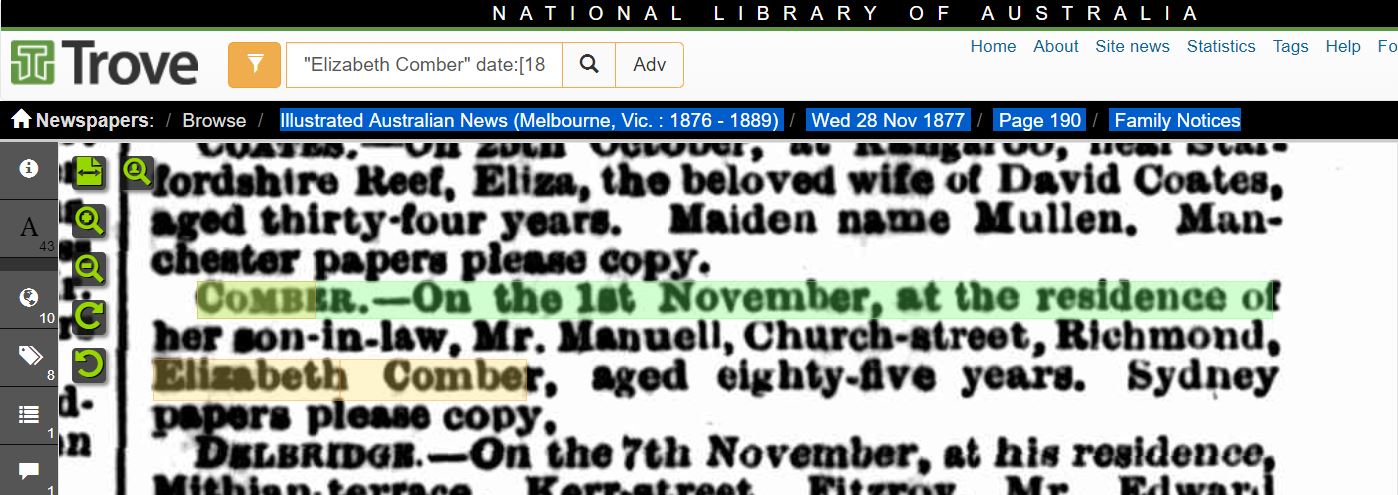
    1877-11-28 - Death Notice - COMBER, Elisabeth (nee Lowe) - Illustrated Australian News pg190
    Illustrated Australian News newspaper
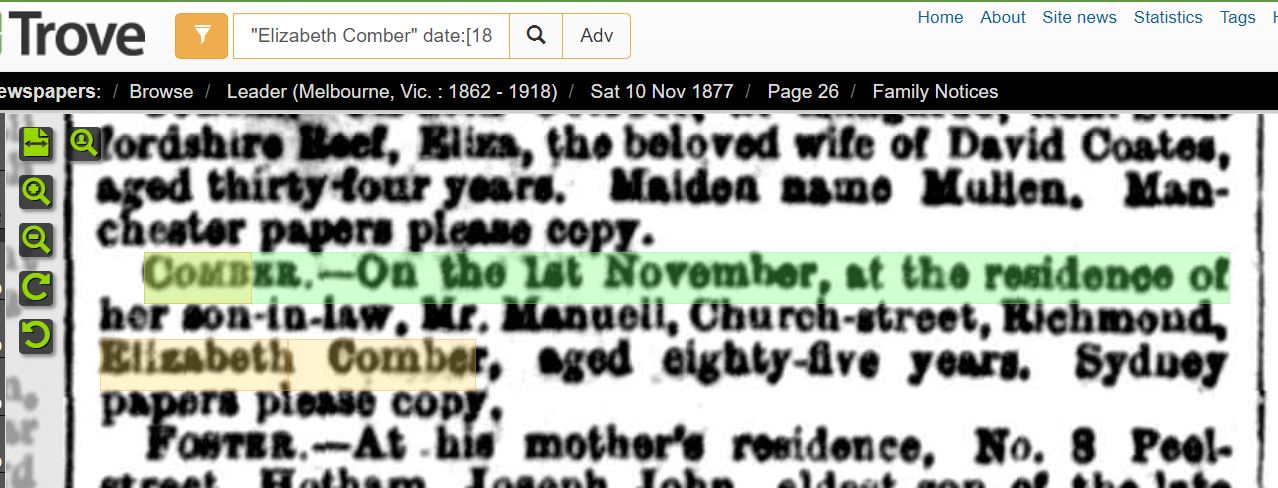
    1877-11-10 - Death Notice - COMBER, Elisabeth (nee Lowe) - Leader Melb pg26
    Leader newspaper
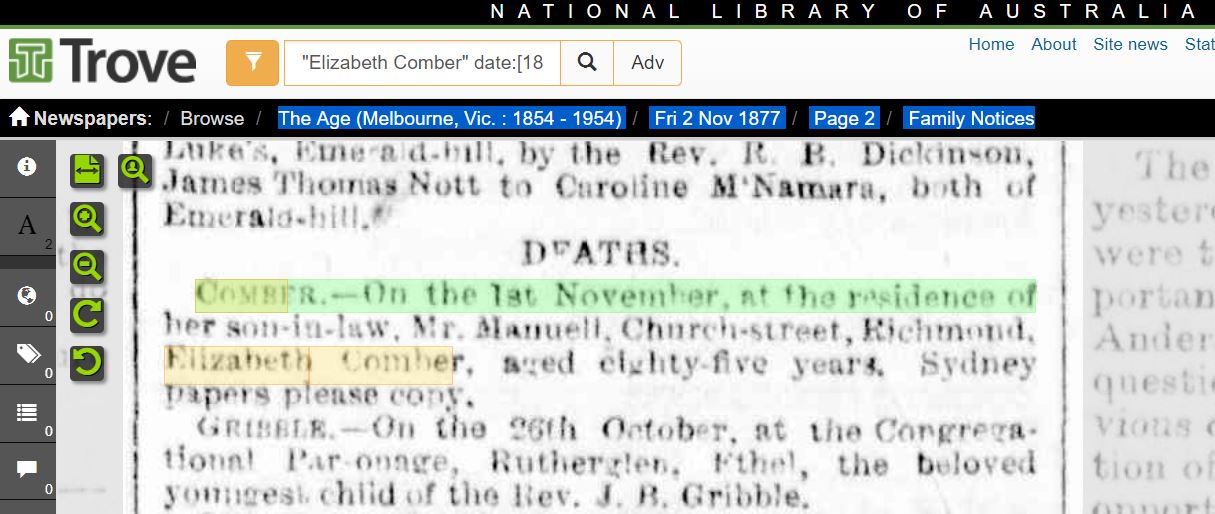
    1877-11-02 - Death Notice - COMBER, Elisabeth (nee Lowe) - The Age pg2
    The Age newspaper

    And, while the content of each newspaper entry contains identical wording, the fact that there IS an entry, and that those entries are made in Melbourne (not Sydney) newspapers, is fascinating.

    Mr. Manuell is Elisabeth’s son-in-law, William, who married daughter Matilda. The Manuells (William and Matilda) had married in Sydney in 1863, but up to this time, it appears that William was actually a Melbournian.

    DEATHS.

    COMBER.- On the 1st November, at the residence of her son-in-law, Mr. Manuell, Church-street, Richmond, Elizabeth Comber, aged eighty-five years. Sydney papers please copy.

    The Manuells lived on the west side of Church Street, Richmond, between Pearson and Adolph Streets, around the vicinity of the current 480 Church Street.

    Now I know have a fair idea what happened to James Comber and Elisabeth (Lowe) Comber after daughter Elisabeth’s marriage in 1863 to James Scoltock.

    My current supposition is that James died around 1876 – but that is purely supposition!

  • The William Turnbull family in the Illawarra District

    This is a brief story of the William Turnbull family in the Illawarra District.

    It encompasses two generations with some descendants and is a work in progress.
    Originally Written: Thursday, 1 February 2018

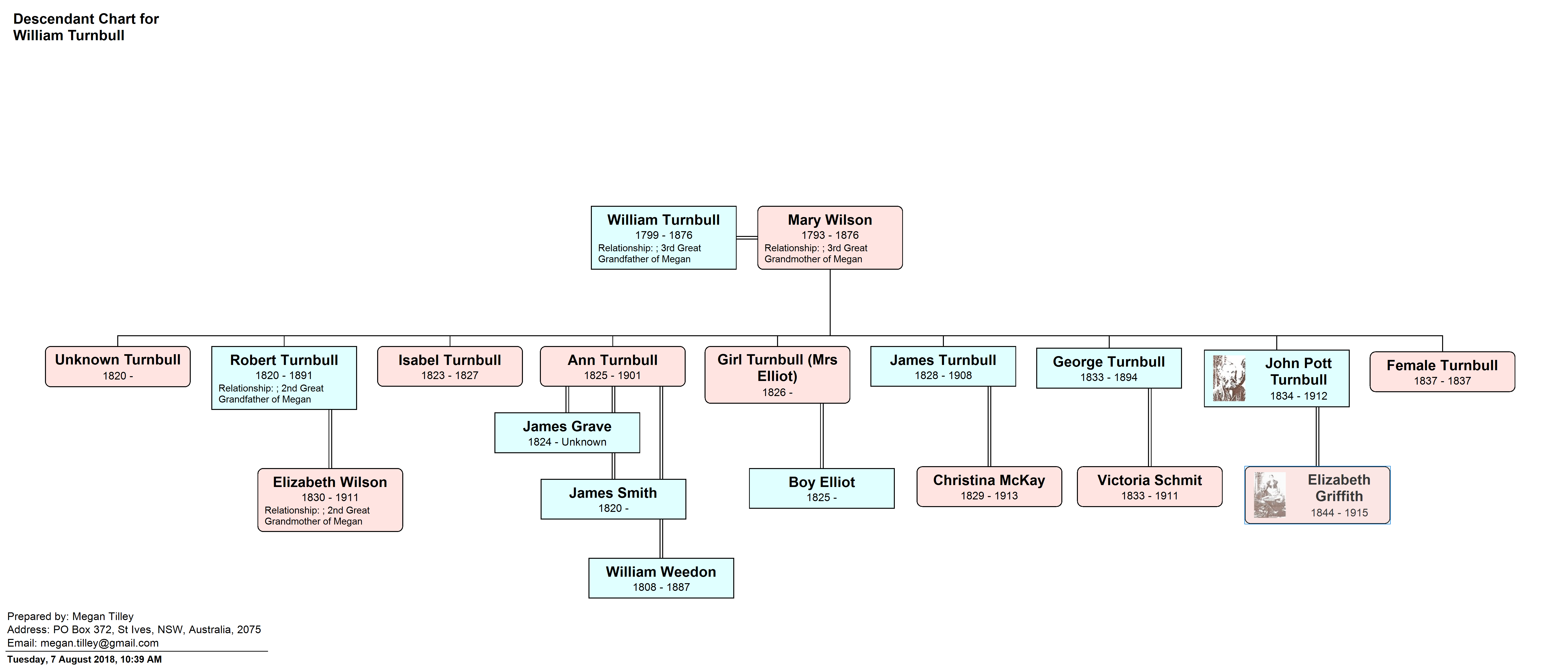
    Descendant Chart for William Turnbull3.png

    William Turnbull === Mary Wilson

    • Robert born 1821 died 1891 in St Peters, Sydney === married Elizabeth Wilson
    • Isobel born 1823 died 1827
    • Ann born 1825 died 1901 in Tasmania === married William Weedon
    • A female child (assumed to have married Mister Elliot) born 1826
    • James born 1828 died 1908 in Thirlmere=== married Christina Hoskins (nee McKay)
    • George born 1833 died 1894 Albion Park=== married Victoria Smith or Schmidt, possibly a widow, sister of Francis (Frank) Smith or Schmidt of Marshall Mount
    • John Pott born 1834 died 1912 March(near Orange) === married Eliza or Elizabeth Griffiths or Griffin (descended from Warringtons) in Dapto area

    William’s parents – Robert Turnbull and Mary Laidlaw (though there is some contention regarding Mary Laidlaw as an Elizabeth and an Agnes are also contenders as Robert Turnbull’s wife).


    William Turnbull – born around 12 July 1799 in Hawick, Roxburghshire, Scotland

    1841 Census - Turnbull family Roxburgshire

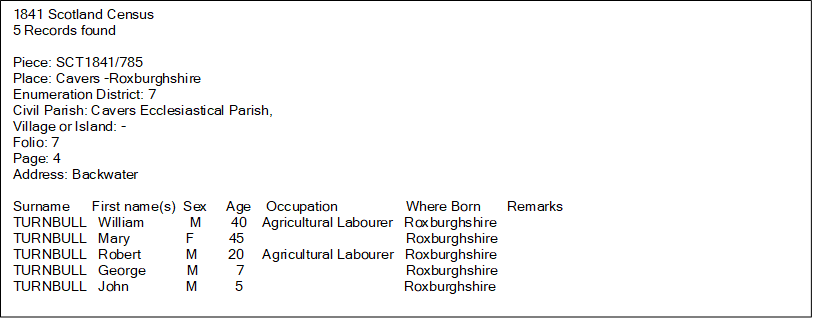
    The first confirmation of the existence of William Turnbull, my third Great Grandfather (3GGF), is in the 1841 Scotland Census, where he is shown with his wife Mary and three sons, Robert, George and John, as living in the Cavers Ecclesiastical Parish, with an address of “Backwater”.

    My relationship with William is via my mother

    1. William Turnbull and Mary Wilson
      • Robert Turnbull and Elizabeth Wilson
        • Jane Turnbull and Henry Miller
          • Harry Frank Turnbull Miller and Isabella Sarah Hardy
            • Elsie Enid Miller and Mark Tilley
              • Megan Tilley(me!)


    The Miller family anecdotes say that William was a very religious Presbyterian, and I have no doubt that he was baptised into the Presbyterian Church. However, during my trip to Hawick in June 2016, and with the help of three archivists in the “Hawick Hub”, the Hawick Local History Archives, we were unable to identify the correct and relevant William Turnbull, son of Robert Turnbull and Mary Laidlaw (or of ‘Elizabeth’ or ‘Agnes’), and thus were unable to confirm a birth and/or a baptism date for William.

    William’s wife Mary Wilson was the daughter of James Wilson and Isabella Newberry.

    James and Isabella had 4 children:

    • Ann baptised 22 Jul 1787
    • James baptised 29 Jun 1789, who died 02 Jan 1824 in the service of Her Majesty as a member of the 91st Highlanders in Jamaica
    • Francis baptised 11 Sep 1791, who married Jane Knox, and Francis and Jane were the parents of Elizabeth Wilson, wife of Robert, the son of William Turnbull and Mary Wilson – thus, Robert and Elizabeth were first cousins. Francis was a Master Shoemaker and Master Bootmaker in Hawick.
    • Mary baptised sometime between 1793 and 1796, who married William Turnbull.

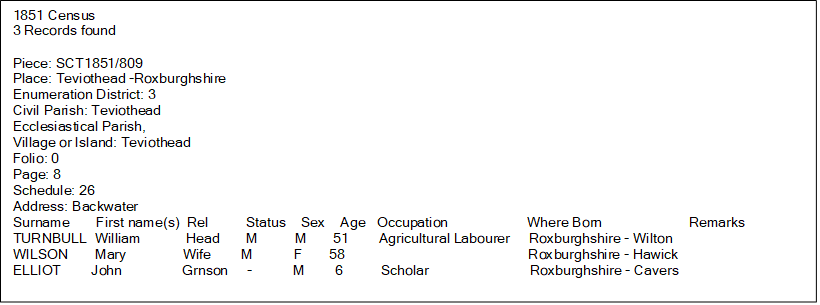
    1851 Census - Turnbull family RoxburgshireThe second confirmation of William’s existence is the 1851 Scotland Census:

    He and wife Mary appear to be still living in “Backwater, Cavers”, but this time only their grandson, John Elliot, is living with them.

    William and Mary had a female child born in 1826. I have made an assumption that this woman married a Mister Elliot, thus producing son John Elliot shown in the 1851 Scotland Census as the Grandson of William and Mary.

    William Turnbull’s parents are almost certainly Robert Turnbull and Mary Laidlaw. Robert was born between 1762 and 1770. Mary was born about 1761 in Denholm, Roxburghshire.

    Robert Turnbull and Elizabeth Wilson

    Turnbull Assisted Immigration

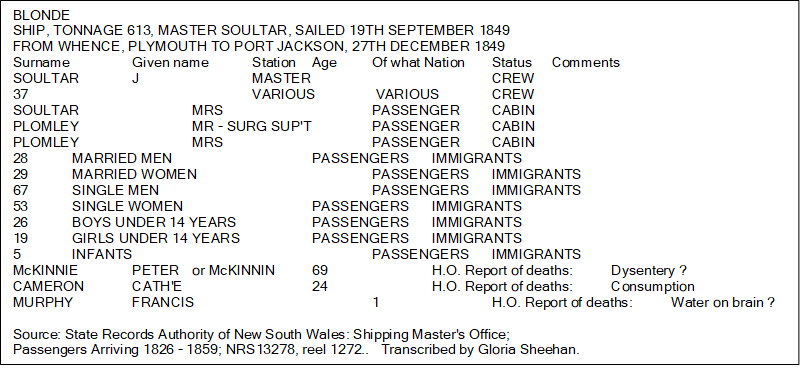
    Robert Turnbull and his wife Elizabeth Wilson do not appear in any Census for 1851 as they had emigrated to New South Wales as assisted immigrants, departing Scotland, or at least the UK, on 19 Sep 1849 and arriving in Sydney on 27 Dec 1849, per the ship BLONDE, by the time of the 1851 Census.

    Accompanying Robert and Elizabeth on the Blonde was Elizabeth’s sister Jane Wilson (born 20 Sep 1828 in Hawick, daughter of Francis Wilson and Jane Knox), who ended up marrying another traveller on the Blonde, William Thorne.  Robert’s occupation at the time of his emigration was shown as “Gardener”.

    Turnbull on Blonde

    Robert and Elizabeth’s trip on the Blonde was not without some trauma:

    They were categorised as one each of the 28 Married Men and 29 Married Women on board the Blonde, which reported three deaths during the journey from the UK to Australia.

    Ann Turnbull

    William and Mary’s daughter Ann was also absent at the time of the 1851 Scotland Census. She had been arrested and convicted for “Precognition … for the crime of child murder, or culpable homicide, or concealment of pregnancy near Mackside farm house, Southdean, Roxburgh” in 1848. She was then working as servant to Potter Elliot, a tenant and widower, living at Mackside, Southdean, Roxburghshire. The situation was a sad one: Ann firstly claimed she was unaware she was pregnant, and then indicated that the child, a boy, was stillborn. As she had no witnesses to the birth, which occurred in a field, she had no support for her statement that the child was born dead. Obviously, the court decided that the child “could” have taken a breath, thus making it a live birth, and so Ann had murdered the child, possibly unintentionally.

    Ann was convicted on 10 Apr 1848 at the court in Jedburgh. It is believed she was either held in Jedburgh or moved to the hulks in the Thames by and from 14 Oct 1848, and eventually was transported on the ship CADET (3) which departed 1 Nov 1848 from Woolwich, and arrived in Van Dieman’s Land on 12 Apr 1849. Ann is reported to have claimed that “James Grave” is the father of the dead child[1]. Others have indicated the father was “John Grane”.

    James Turnbull

    William and Mary’s son James does not appear in either the 1841 Scotland Census or the 1851 Scotland Census. It is believed that James was working as a servant or agricultural labourer on another property, possibly for one of his Turnbull relations. It is hard to determine the details of an individual without firm base data from which to search!

    George Turnbull

    William and Mary’s son George is present in the 1851 Scotland Census, and is shown working for the Potts family in Grundistone which may be a property name or a locality near Wilton, Roxburghshire.

    George appears as an Assisted Immigrant on the ship ANN THOMPSON departing London, England on 01 Sep 1852 and arriving in Geelong, in Port Phillip on 25 Dec 1852.

    John Pott Turnbull

    William and Mary’s son John Pott (at the present time, my family can only speculate that the “Pott” in his name is some reference to the family that James was working for in the 1851 Scotland Census), is also absent from the 1851 Scotland Census. It is possible that he is working for someone else, but again, without the firm base data from which to search it is difficult to be certain where he is located in 1851. It is possible that both he and his brother James have made their way to NSW by this time, but that, too, is an uncertain assumption.

    Family Anecdotes

    My grandmother, Isabella Sarah Hardy Miller, wife of Harry Frank Turnbull Miller, related a family anecdote that Robert Turnbull and his wife Elizabeth Wilson emigrated from Scotland to New South Wales in 1849 on the ship BLONDE and that Robert’s parents, William and Mary, followed them to New South Wales about 5 years later and settled at Marshall Mount, near Dapto.

    As of January 2018, there have been no arrivals in Australia of:

    • A married couple, William and Mary Turnbull
    • Two separate individuals arriving separately as a William Turnbull and a Mary Turnbull
    • William Turnbull travelling with one or more of his sons
    • Mary Turnbull travelling with one or more of her sons
    • As Assisted Immigrants to New South Wales
    • As Assisted Immigrants to Victoria
    • As Unassisted Immigrants to New South Wales
    • As Unassisted Immigrants to Victoria
    • As Unassisted Immigrants to Queensland
    • As Assisted Immigrants to Queensland

    It remains a puzzle as to how and when William and Mary Turnbull arrived in New South Wales.

    Research

    During a visit to the Illawarra District in January 2018, I managed to find one piece of correspondence with relevance to the Turnbull family in the area from the Illawarra Family History Group.

    A lady, Mrs Young, had written to the Research Officer of the Illawarra Family History Group (hereafter “IFHG”) in July 1986, requesting assistance in finding out more about the Turnbull family in the District. A series of letters were exchanged as details were found in the IFHG archives. Suffice to say, it was determined by Mrs Young that the brothers James, George [2]and John Turnbull all arrived within a few years of each other – between 1855 and 1856.

    There is some confusing information regarding a William and Mary Turnbull in the Hawkesbury Region (reference “Hawkesbury Pioneer Register”) but I have managed to discount that with reference to ‘my’ Turnbulls as the ages do not fit, nor do the family names.

    Son Robert and wife Elizabeth are shown to be in the Wollongong area on the 17 Feb 1853, for the birth of their daughter, Jane (my Great Grandmother) at Marshall Mount. Robert is 32 years of age, and wife Elizabeth is 23. In the next few years, William (1855), Isabella (1857), Mary (1860), Alexander J (1862), Elizabeth “Lizzie” (c1863), Francis “Frank” (1864), Robert (1867), and George (1870) are all reported to have been born or registered in the Wollongong area, with Robert specifically being born or registered in Dapto. It is interesting to note that Mrs Young mentioned in one of her letters to the IFHG that Robert was a farmer in Dunheved near Penrith in 1860.

    My assumption is that Dunheved was a property near Penrith.

    By 30 Oct 1879, Robert was in St Peters as the Sexton of the St Peter’s Anglican Church (Now known as St Peters (Cooks River) Anglican Church). The family resided in Brown Street, St Peters.

    Again, Mrs Young states that William Turnbull, who was alive and living in Marshall Mount in 1872, wrote a letter to his son, John Pott Turnbull, on the 10 Jan 1872. It was a very religious letter, and that possibly William was connected with one of the local churches (in the Illawarra District) due to his religion. This information supports the Miller family anecdote of William being fiercely Presbyterian!

    Brother James is obviously still in the Marshall Mount area by 1866 as there are is an advertisement in the local newspaper:

    Turnbull Onions

    James also registered a livestock brand on 18 May 1868 while located at Marshall Mount. James married a widow, Christina McKay (who had previously married a Hoskins) on 03 Feb 1886 at the Registrar’s Office in Sydney. James died in Thirlmere on 28 Aug 1908 suffering from Cancer of the Stomach & Asthenia (wasting away). Christina died on 30 May 1913 in the family home at St Elmo, Thirlmere.

    Brother John Pott married Eliza Griffin on 20 Jul 1864 in Dapto. Eliza was also known as Elizabeth Griffith. She was born in Albion Park on 23 Aug 1844 and was baptised 22 Oct 1844 again at Albion Park, most probably at the Presbyterian church there. Eliza was the daughter of James Griffith, who had changed his name to Griffin to avoid confusion between him and his brother John.[3] James married Mary Warrington on 18 Oct 1842 in Sydney. Mary had been born in Aghabog, Monaghan, Ireland around 1820 and had arrived in New South Wales with her parents, John Warrington and Jane Williamson, in 1840 per the ship LORD WESTON.

    By about 1865, John Pott Turnbull and his wife Eliza (nee Griffin/Griffith) relocated to March near Orange with most of the Griffith family, as the land holdings in that area register many Griffin, Griffith, and Warrington names, which was mother Mary Griffin’s maiden name.

    George Turnbull married Victoria Smith or possibly Victoria Schmidt on 11 Sep 1878 at Dapto. Victoria was the widow of Francis J “Frank” Schmidt and had had 7 children with him. Victoria and Frank had married before 1860, and it is thought they were both of German origin. This is yet to be proved.

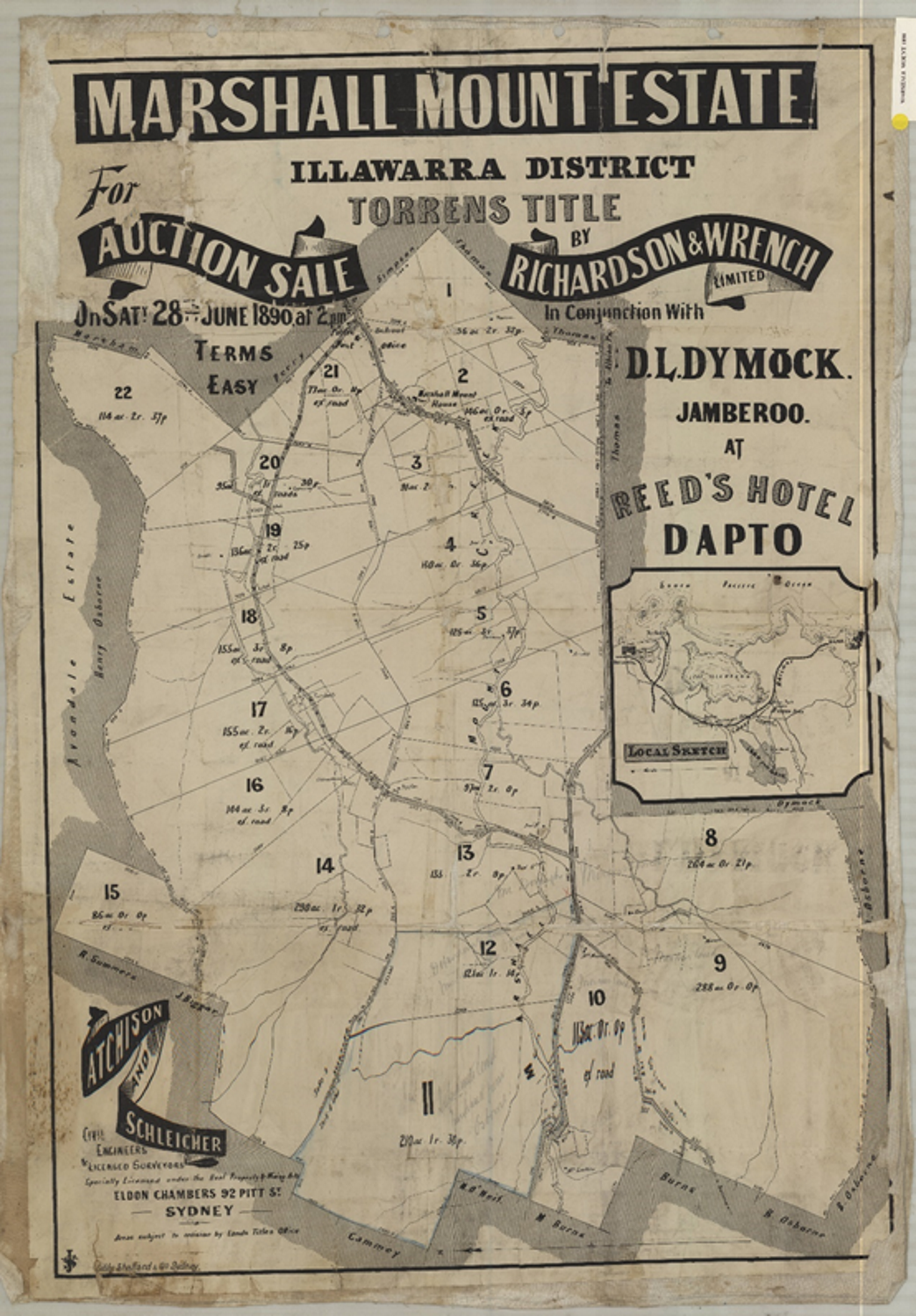
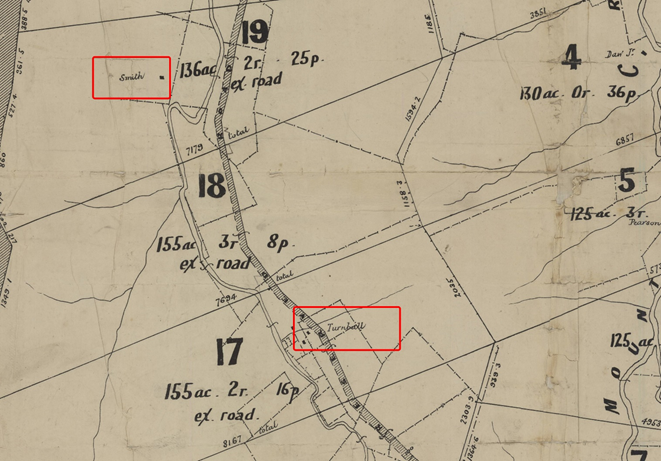
    It appears that the Turnbull farm and the Smith farm were co-located in the Marshall Mount area.  It was known in the Marshall Mount area that George had acquired land in somewhere in Albion Park.

    Marshall Mount Estate map large

    Figure 1 – 1890 Land Sketch Map of the Marshall Mount Estate sale showing Turnbull and Smith leases

    Marshall Mount Estate map excerpt showing Turnbull & Schmit

    Figure 2- enlarged area of map showing co-location of Turnbull and Smith leases

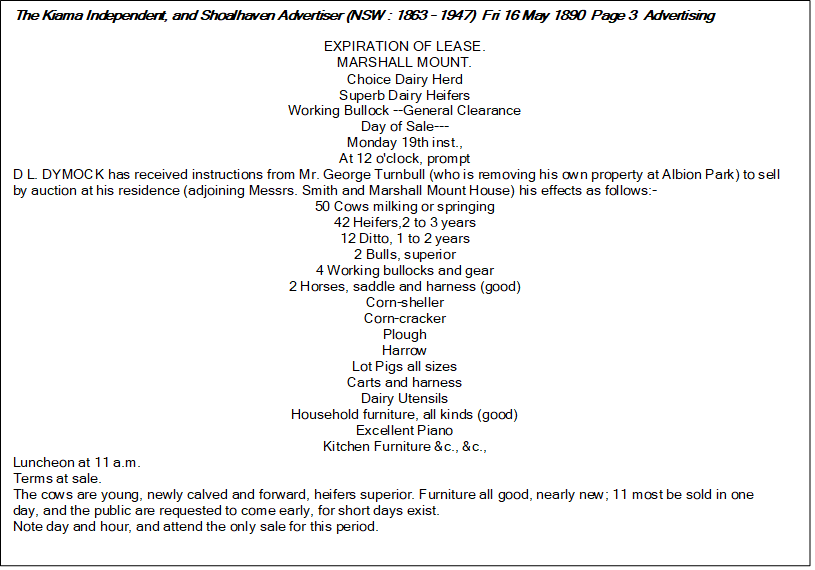
    George was involved in his own sale at Marshall Mount on 16 May 1890, where he advertised:

    1890 Estate Sale ad

    George appeared in the 1891 Australian Census living in his Albion Park home:

    Albion Park – Geo Turnbull – (No of Householder’s schedule) 100 – 2 males – 4 females

    This household was apparently comprised of George and Victoria and four of Victoria’s children. This information has not been proved.

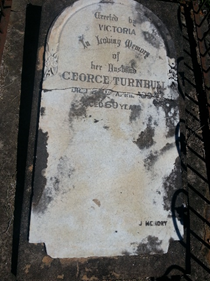
    George died 27 Apr 1894 and Victoria provided a headstone for his grave, which was in the Presbyterian Cemetery at Albion Park, now the Pioneer Cemetery.

    George tombstone

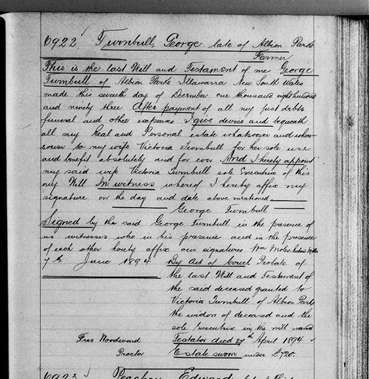
    George’s Will was probated 7 Jun 1894.

    George Will

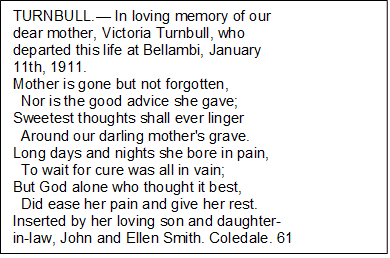
    Victoria died 11 Jan 1911, and her son, John Smith entered an “In Memory” item in the South Coast Times and Wollongong Argus a year to the day after Victoria’s death:

    Victoria memorial

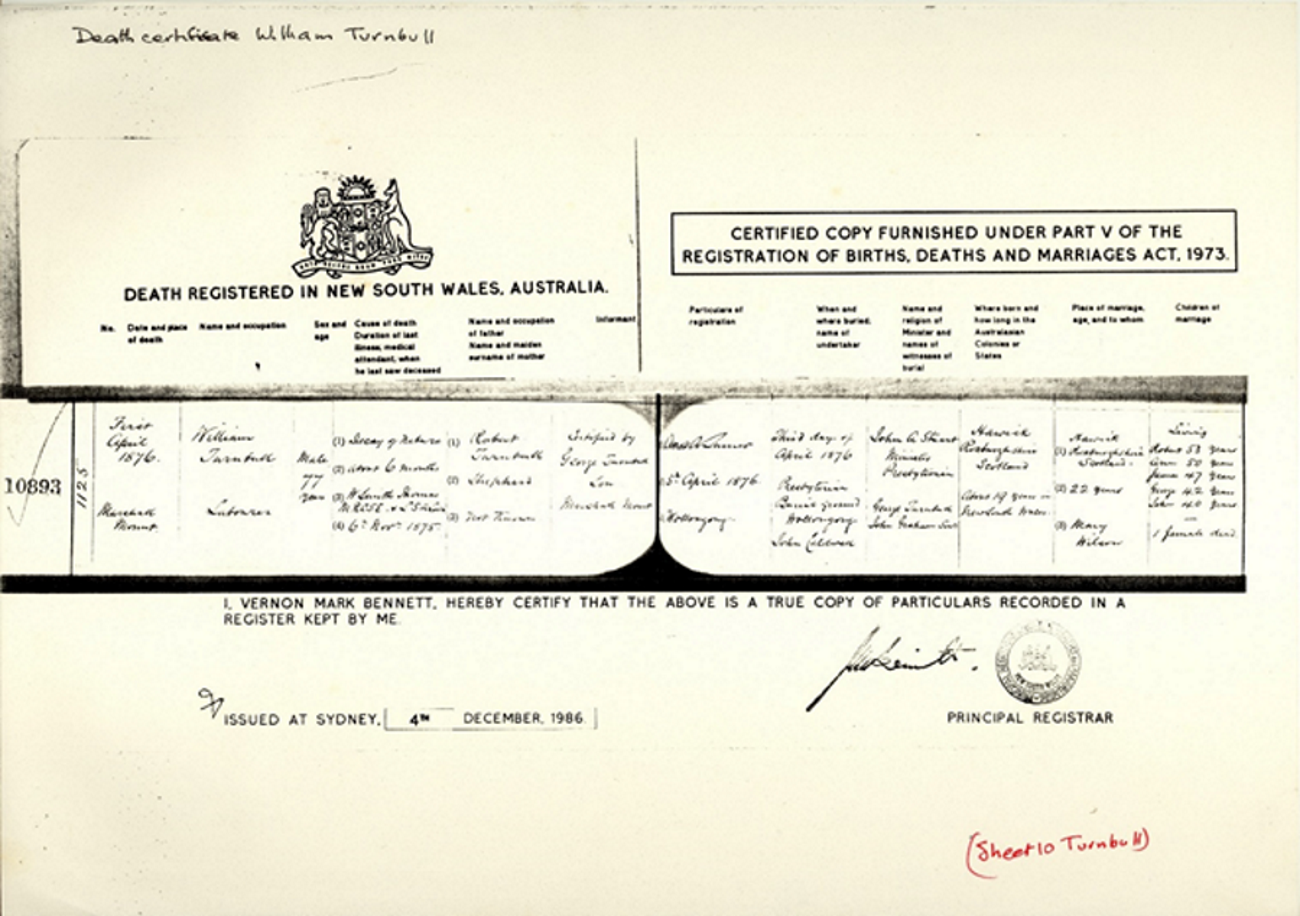
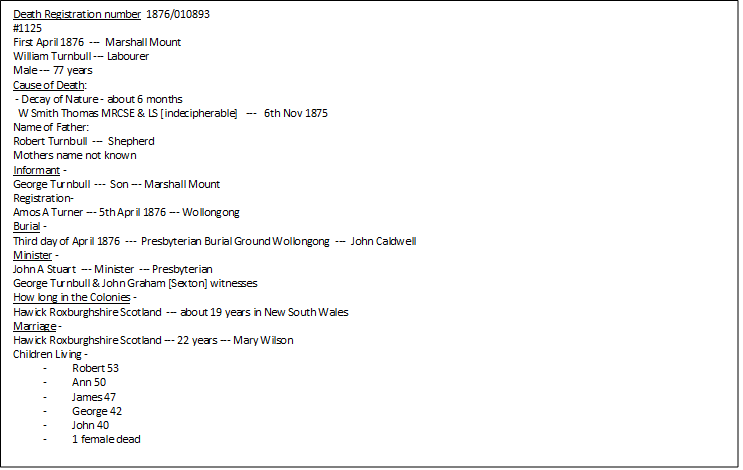
    William Turnbull died on 01 Apr 1876 at Marshall Mount.

    Turnbull William Death certTurnbull William Death cert transcription

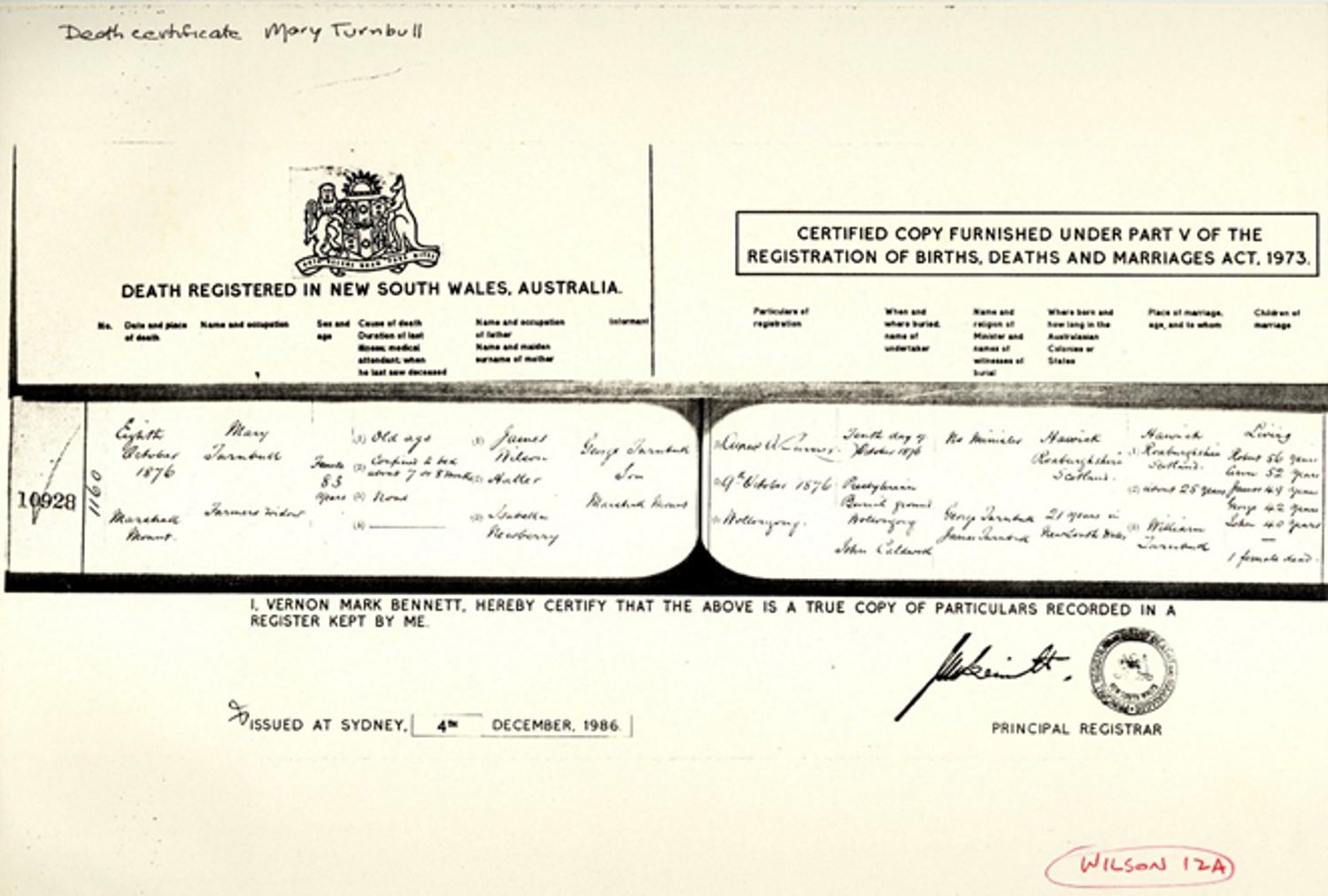
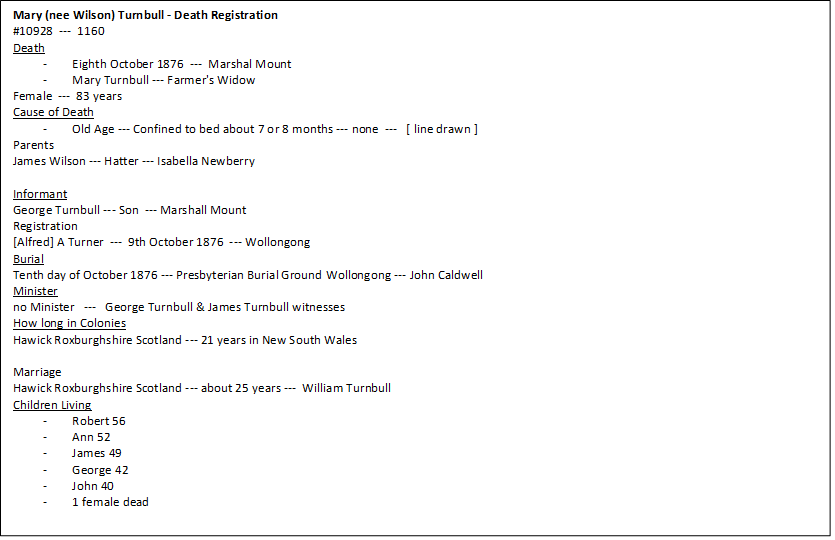
    Wife Mary Wilson Turnbull died 5 months later, on 08 Oct 1876.

    Turnbull Mary Death CertTurnbull Mary Death Cert transcription

    Son Robert died 30 Sep 1891 at Brown Street St Peters and is buried in the St Peter’s Anglican Churchyard.

    Elizabeth died 26 Apr 1911 at her home at 46 Brown Street St Peters, and is buried at St Thomas’ Enfield; one of her daughters was living in Enfield at the time of Elizabeth’s death.

    Their daughter Jane Turnbull married Henry Miller (born Henry Miller Dixon in Coventry in Jan 1836) on 30 Oct 1872 in Redfern. They had three children:

    • A girl born and died about 1873
    • Harriet Maude Miller born 06 Sep 1874 at Thompson Street, Darlinghurst, married Charles Valentine Munro in 1894:
      • Alice Munro born 1895
      • Edmund (Ted) Harry Munro born about 04 May 1899

    Sadly, Harriet Maude died from septicaemia at Ted’s birth.

    • Harry Frank Turnbull Miller born 05 Jun 1881, married Isabella Sarah Hardy on 20 Oct 1906 at Kurri Kurri, and they had:
      • Mildred Elizabeth Isabel Miller born 1907
      • Henry Edmund “Harry” Miller born 1909
      • Stanley Robert Miller born 1912
      • Elsie Enid Miller born 1914
      • Jessie Maud Miller born 1917
      • Lorna Hazel Miller born 1918
      • Alan Edgar Miller born 1921
      • Denison Hunter Miller born 1923
      • Harold John “Jack” Miller born 1927

    Harry Frank enlisted in the 2nd NSW Mounted Rifles in 1901 and fought in the Boer War in South Africa. He died in 1950. His wife Isabella Sarah died in 1971.

    Henry died 28 Jul 1906 and Jane married again to Edmund Williams, a miner from Cornwall on 10 Sep 1906.

    Jane Turnbull Miller Williams died at the age of 89 on 16 Jun 1942 at Mayfield and is buried in Sandgate Cemetery. She and Henry had moved to Newcastle after their marriage. Jane had bought quite a lot of property in the Newcastle area, especially land along Railway Street in Hamilton.

    Oh, and I’ll bet you’re asking about William and Mary’s daughter Ann, who had been transported to Van Dieman’s Land!!!

    Ann had been sentenced to 10 years transportation. Having arrived in VDL on the ship CADET (3) on 12 Apr 1849, she was in/at the Brickfields Hiring Depot 06 Apr 1852. The next day, 07 Apr 1852, she was assigned to J Webb of “Little Hampton”. After that, she was assigned to William Crooke of Elizabeth Street, Hobart.

    She had her Ticket of Leave granted on 22 Feb 1853 and her Conditional Pardon granted 21 Feb 1854, then approved 19 Dec 1854. On 14 Apr 1858, she was considered “Freed by Servitude”.

    On 22 Jun 1853, she married another convict, William Weedon, in Bishopbourne, having been granted Permission to Marry.

    Ann and William had five children:

    • William born 01 Apr 1854 in Oaks, Tasmania
    • John born in 1855
    • James born 20 Apr 1857 in Oaks
    • Ann or Annie born 21 Nov 1858 in Westbury
    • Robert George born 19 Oct 1867

    Ann died 02 Jan 1901 in Glenore, Tasmania. It was said that her children were all named for the men in her Turnbull family – William, John, James, Robert and George. Someone once commented that they thought her brother, John Pott Turnbull, had visited her regularly in Tasmania, but I have not found any proof that any of her Turnbull family made contact with her.

    Footnotes

    [1] Data from “Female Convicts in VDL database” – Ann TURNBULL – Id 3187 – Police ID 347

    [2] As indicated previously, George Turnbull arrived in Geelong on 25 Dec 1852 per the ANN THOMPSON.

    [3] James Griffin had a brother JOHN GRIFFITH (hence the change to Griffin to avoid confusion on having two J. GRIFFITHs).