Author: megadmin

  • The William Turnbull family in the Illawarra District

    This is a brief story of the William Turnbull family in the Illawarra District.

    It encompasses two generations with some descendants and is a work in progress.

    Originally Written: Thursday, 1 February 2018
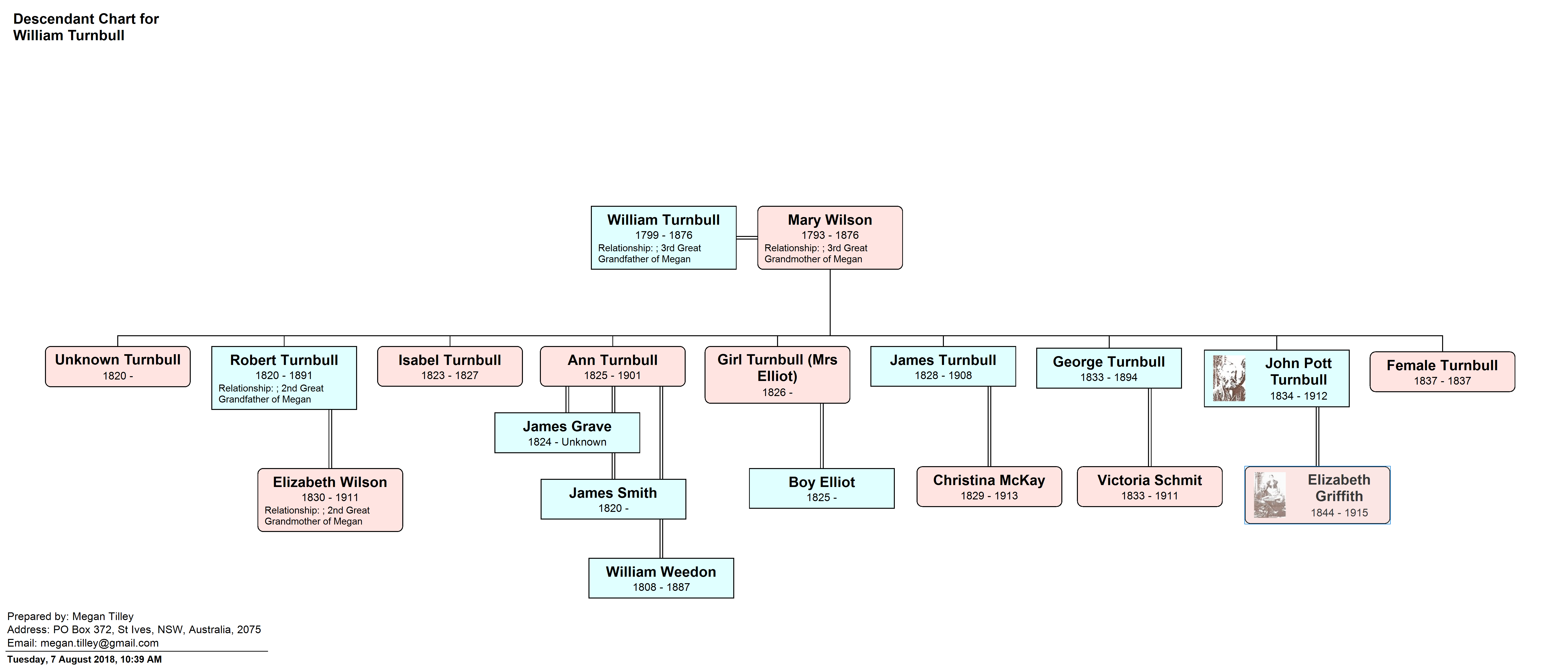
    Descendant Chart for William Turnbull3.png

    William Turnbull === Mary Wilson

    • Robert born 1821 died 1891 in St Peters, Sydney === married Elizabeth Wilson
    • Isobel born 1823 died 1827
    • Ann born 1825 died 1901 in Tasmania === married William Weedon
    • A female child (assumed to have married Mister Elliot) born 1826
    • James born 1828 died 1908 in Thirlmere=== married Christina Hoskins (nee McKay)
    • George born 1833 died 1894 Albion Park=== married Victoria Smith or Schmidt, possibly a widow, sister of Francis (Frank) Smith or Schmidt of Marshall Mount
    • John Pott born 1834 died 1912 March(near Orange) === married Eliza or Elizabeth Griffiths or Griffin (descended from Warringtons) in Dapto area

    William’s parents – Robert Turnbull and Mary Laidlaw (though there is some contention regarding Mary Laidlaw as an Elizabeth and an Agnes are also contenders as Robert Turnbull’s wife).


    William Turnbull – born around 12 July 1799 in Hawick, Roxburghshire, Scotland
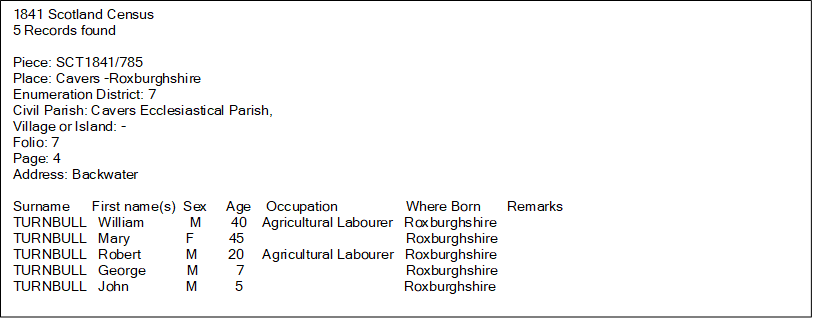
    1841 Census - Turnbull family Roxburgshire

    The first confirmation of the existence of William Turnbull, my third Great Grandfather (3GGF), is in the 1841 Scotland Census, where he is shown with his wife Mary and three sons, Robert, George and John, as living in the Cavers Ecclesiastical Parish, with an address of “Backwater”.

    My relationship with William is via my mother

    1. William Turnbull and Mary Wilson
      • Robert Turnbull and Elizabeth Wilson
        • Jane Turnbull and Henry Miller
          • Harry Frank Turnbull Miller and Isabella Sarah Hardy
            • Elsie Enid Miller and Mark Tilley
              • Megan Tilley(me!)


    The Miller family anecdotes say that William was a very religious Presbyterian, and I have no doubt that he was baptised into the Presbyterian Church. However, during my trip to Hawick in June 2016, and with the help of three archivists in the “Hawick Hub”, the Hawick Local History Archives, we were unable to identify the correct and relevant William Turnbull, son of Robert Turnbull and Mary Laidlaw (or of ‘Elizabeth’ or ‘Agnes’), and thus were unable to confirm a birth and/or a baptism date for William.

    William’s wife Mary Wilson was the daughter of James Wilson and Isabella Newberry.

    James and Isabella had 4 children:

    • Ann baptised 22 Jul 1787
    • James baptised 29 Jun 1789, who died 02 Jan 1824 in the service of Her Majesty as a member of the 91st Highlanders in Jamaica
    • Francis baptised 11 Sep 1791, who married Jane Knox, and Francis and Jane were the parents of Elizabeth Wilson, wife of Robert, the son of William Turnbull and Mary Wilson – thus, Robert and Elizabeth were first cousins. Francis was a Master Shoemaker and Master Bootmaker in Hawick.
    • Mary baptised sometime between 1793 and 1796, who married William Turnbull.
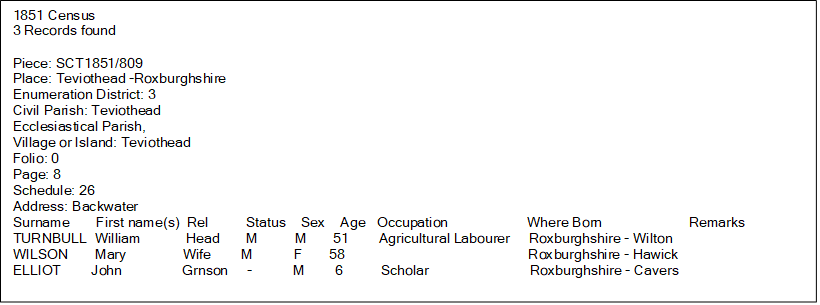
    1851 Census - Turnbull family RoxburgshireThe second confirmation of William’s existence is the 1851 Scotland Census:

    He and wife Mary appear to be still living in “Backwater, Cavers”, but this time only their grandson, John Elliot, is living with them.

    William and Mary had a female child born in 1826. I have made an assumption that this woman married a Mister Elliot, thus producing son John Elliot shown in the 1851 Scotland Census as the Grandson of William and Mary.

    William Turnbull’s parents are almost certainly Robert Turnbull and Mary Laidlaw. Robert was born between 1762 and 1770. Mary was born about 1761 in Denholm, Roxburghshire.

    Robert Turnbull and Elizabeth Wilson

    Turnbull Assisted Immigration

    Robert Turnbull and his wife Elizabeth Wilson do not appear in any Census for 1851 as they had emigrated to New South Wales as assisted immigrants, departing Scotland, or at least the UK, on 19 Sep 1849 and arriving in Sydney on 27 Dec 1849, per the ship BLONDE, by the time of the 1851 Census.

    Accompanying Robert and Elizabeth on the Blonde was Elizabeth’s sister Jane Wilson (born 20 Sep 1828 in Hawick, daughter of Francis Wilson and Jane Knox), who ended up marrying another traveller on the Blonde, William Thorne.  Robert’s occupation at the time of his emigration was shown as “Gardener”.
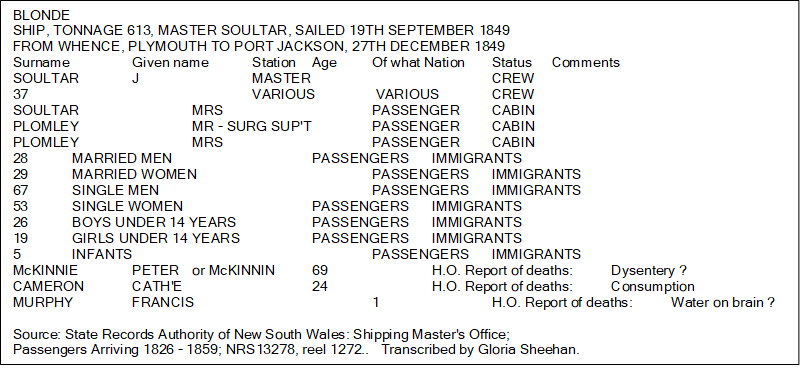
    Turnbull on Blonde

    Robert and Elizabeth’s trip on the Blonde was not without some trauma:

    They were categorised as one each of the 28 Married Men and 29 Married Women on board the Blonde, which reported three deaths during the journey from the UK to Australia.

    Ann Turnbull

    William and Mary’s daughter Ann was also absent at the time of the 1851 Scotland Census. She had been arrested and convicted for “Precognition … for the crime of child murder, or culpable homicide, or concealment of pregnancy near Mackside farm house, Southdean, Roxburgh” in 1848. She was then working as servant to Potter Elliot, a tenant and widower, living at Mackside, Southdean, Roxburghshire. The situation was a sad one: Ann firstly claimed she was unaware she was pregnant, and then indicated that the child, a boy, was stillborn. As she had no witnesses to the birth, which occurred in a field, she had no support for her statement that the child was born dead. Obviously, the court decided that the child “could” have taken a breath, thus making it a live birth, and so Ann had murdered the child, possibly unintentionally.

    Ann was convicted on 10 Apr 1848 at the court in Jedburgh. It is believed she was either held in Jedburgh or moved to the hulks in the Thames by and from 14 Oct 1848, and eventually was transported on the ship CADET (3) which departed 1 Nov 1848 from Woolwich, and arrived in Van Dieman’s Land on 12 Apr 1849. Ann is reported to have claimed that “James Grave” is the father of the dead child[1]. Others have indicated the father was “John Grane”.

    James Turnbull

    William and Mary’s son James does not appear in either the 1841 Scotland Census or the 1851 Scotland Census. It is believed that James was working as a servant or agricultural labourer on another property, possibly for one of his Turnbull relations. It is hard to determine the details of an individual without firm base data from which to search!

    George Turnbull

    William and Mary’s son George is present in the 1851 Scotland Census, and is shown working for the Potts family in Grundistone which may be a property name or a locality near Wilton, Roxburghshire.

    George appears as an Assisted Immigrant on the ship ANN THOMPSON departing London, England on 01 Sep 1852 and arriving in Geelong, in Port Phillip on 25 Dec 1852.

    John Pott Turnbull

    William and Mary’s son John Pott (at the present time, my family can only speculate that the “Pott” in his name is some reference to the family that James was working for in the 1851 Scotland Census), is also absent from the 1851 Scotland Census. It is possible that he is working for someone else, but again, without the firm base data from which to search it is difficult to be certain where he is located in 1851. It is possible that both he and his brother James have made their way to NSW by this time, but that, too, is an uncertain assumption.

    Family Anecdotes

    My grandmother, Isabella Sarah Hardy Miller, wife of Harry Frank Turnbull Miller, related a family anecdote that Robert Turnbull and his wife Elizabeth Wilson emigrated from Scotland to New South Wales in 1849 on the ship BLONDE and that Robert’s parents, William and Mary, followed them to New South Wales about 5 years later and settled at Marshall Mount, near Dapto.

    As of January 2018, there have been no arrivals in Australia of:

    • A married couple, William and Mary Turnbull
    • Two separate individuals arriving separately as a William Turnbull and a Mary Turnbull
    • William Turnbull travelling with one or more of his sons
    • Mary Turnbull travelling with one or more of her sons
    • As Assisted Immigrants to New South Wales
    • As Assisted Immigrants to Victoria
    • As Unassisted Immigrants to New South Wales
    • As Unassisted Immigrants to Victoria
    • As Unassisted Immigrants to Queensland
    • As Assisted Immigrants to Queensland

    It remains a puzzle as to how and when William and Mary Turnbull arrived in New South Wales.

    Research

    During a visit to the Illawarra District in January 2018, I managed to find one piece of correspondence with relevance to the Turnbull family in the area from the Illawarra Family History Group.

    A lady, Mrs Young, had written to the Research Officer of the Illawarra Family History Group (hereafter “IFHG”) in July 1986, requesting assistance in finding out more about the Turnbull family in the District. A series of letters were exchanged as details were found in the IFHG archives. Suffice to say, it was determined by Mrs Young that the brothers James, George [2]and John Turnbull all arrived within a few years of each other – between 1855 and 1856.

    There is some confusing information regarding a William and Mary Turnbull in the Hawkesbury Region (reference “Hawkesbury Pioneer Register”) but I have managed to discount that with reference to ‘my’ Turnbulls as the ages do not fit, nor do the family names.

    Son Robert and wife Elizabeth are shown to be in the Wollongong area on the 17 Feb 1853, for the birth of their daughter, Jane (my Great Grandmother) at Marshall Mount. Robert is 32 years of age, and wife Elizabeth is 23. In the next few years, William (1855), Isabella (1857), Mary (1860), Alexander J (1862), Elizabeth “Lizzie” (c1863), Francis “Frank” (1864), Robert (1867), and George (1870) are all reported to have been born or registered in the Wollongong area, with Robert specifically being born or registered in Dapto. It is interesting to note that Mrs Young mentioned in one of her letters to the IFHG that Robert was a farmer in Dunheved near Penrith in 1860.

    My assumption is that Dunheved was a property near Penrith.

    By 30 Oct 1879, Robert was in St Peters as the Sexton of the St Peter’s Anglican Church (Now known as St Peters (Cooks River) Anglican Church). The family resided in Brown Street, St Peters.

    Again, Mrs Young states that William Turnbull, who was alive and living in Marshall Mount in 1872, wrote a letter to his son, John Pott Turnbull, on the 10 Jan 1872. It was a very religious letter, and that possibly William was connected with one of the local churches (in the Illawarra District) due to his religion. This information supports the Miller family anecdote of William being fiercely Presbyterian!

    Brother James is obviously still in the Marshall Mount area by 1866 as there are is an advertisement in the local newspaper:
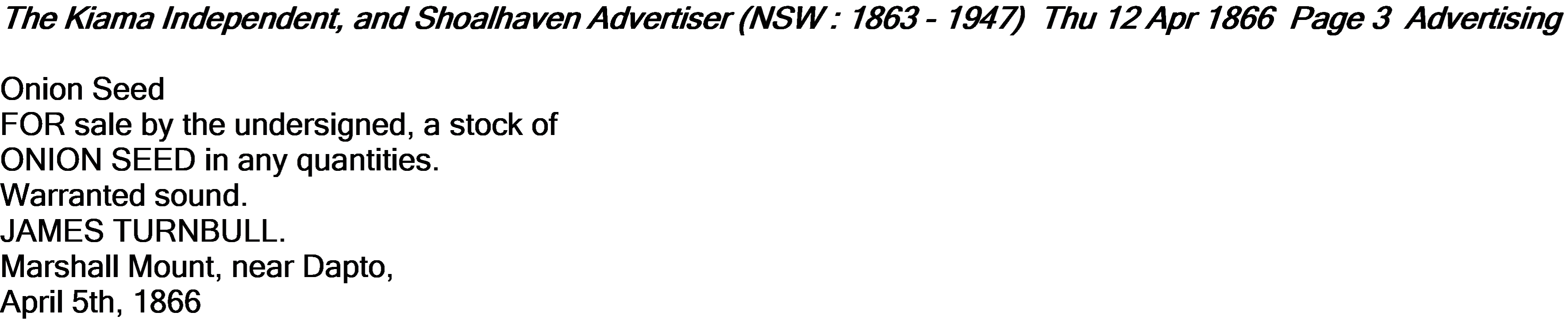
    Turnbull Onions

    James also registered a livestock brand on 18 May 1868 while located at Marshall Mount. James married a widow, Christina McKay (who had previously married a Hoskins) on 03 Feb 1886 at the Registrar’s Office in Sydney. James died in Thirlmere on 28 Aug 1908 suffering from Cancer of the Stomach & Asthenia (wasting away). Christina died on 30 May 1913 in the family home at St Elmo, Thirlmere.

    Brother John Pott married Eliza Griffin on 20 Jul 1864 in Dapto. Eliza was also known as Elizabeth Griffith. She was born in Albion Park on 23 Aug 1844 and was baptised 22 Oct 1844 again at Albion Park, most probably at the Presbyterian church there. Eliza was the daughter of James Griffith, who had changed his name to Griffin to avoid confusion between him and his brother John.[3] James married Mary Warrington on 18 Oct 1842 in Sydney. Mary had been born in Aghabog, Monaghan, Ireland around 1820 and had arrived in New South Wales with her parents, John Warrington and Jane Williamson, in 1840 per the ship LORD WESTON.

    By about 1865, John Pott Turnbull and his wife Eliza (nee Griffin/Griffith) relocated to March near Orange with most of the Griffith family, as the land holdings in that area register many Griffin, Griffith, and Warrington names, which was mother Mary Griffin’s maiden name.

    George Turnbull married Victoria Smith or possibly Victoria Schmidt on 11 Sep 1878 at Dapto. Victoria was the widow of Francis J “Frank” Schmidt and had had 7 children with him. Victoria and Frank had married before 1860, and it is thought they were both of German origin. This is yet to be proved.

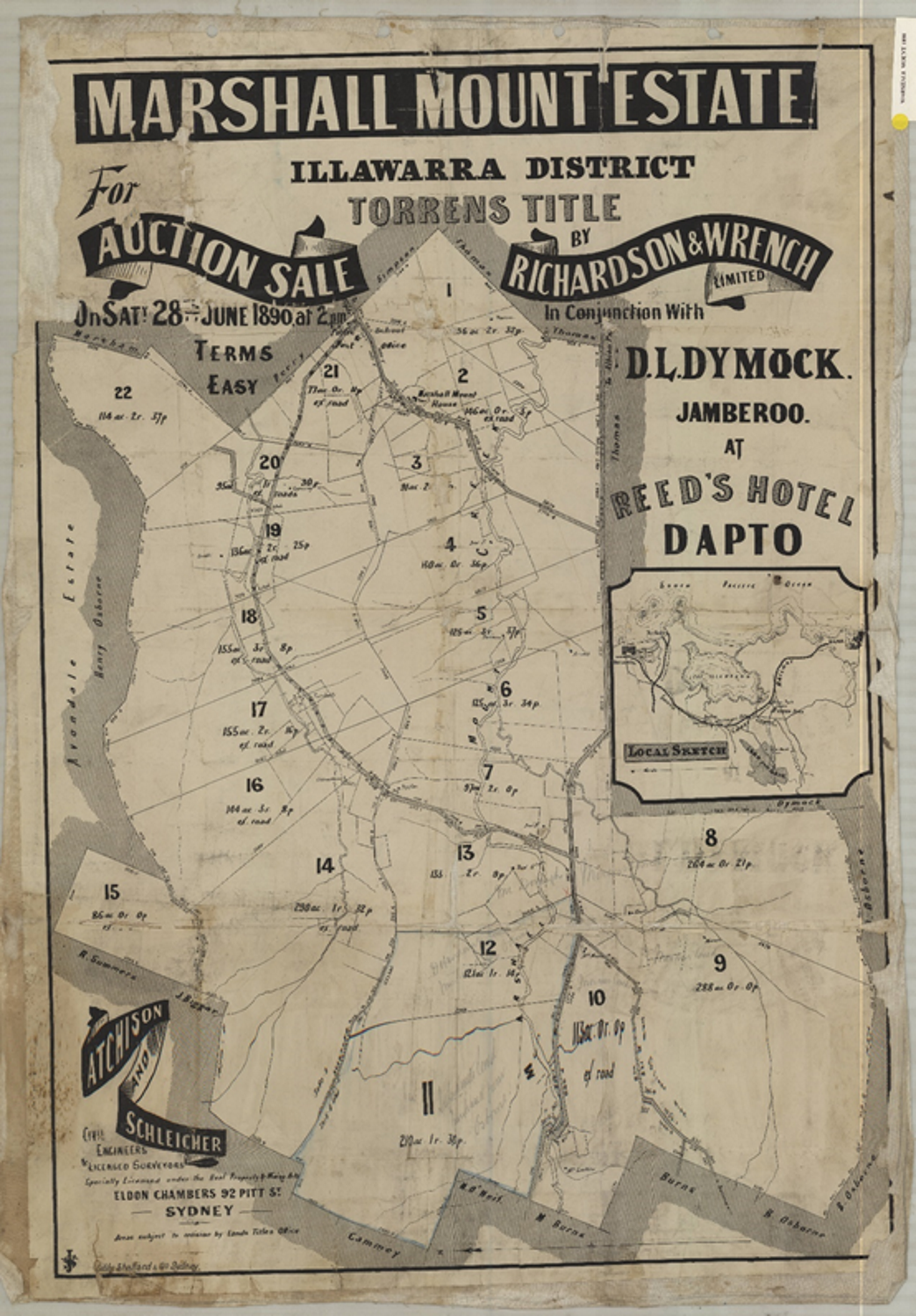
    It appears that the Turnbull farm and the Smith farm were co-located in the Marshall Mount area.  It was known in the Marshall Mount area that George had acquired land in somewhere in Albion Park.
    Marshall Mount Estate map large

    Figure 1 – 1890 Land Sketch Map of the Marshall Mount Estate sale showing Turnbull and Smith leases
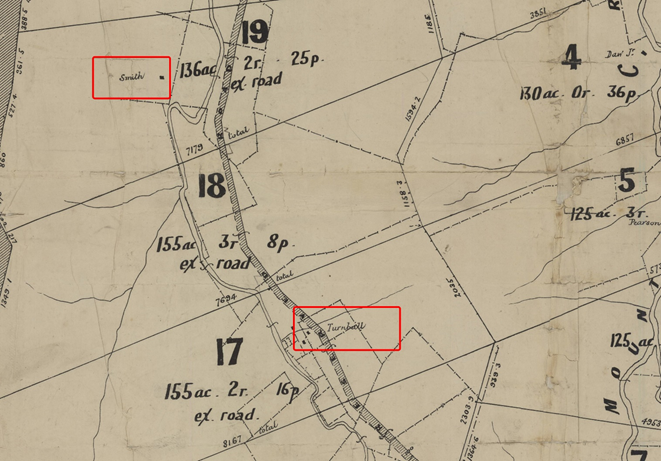
    Marshall Mount Estate map excerpt showing Turnbull & Schmit

    Figure 2- enlarged area of map showing co-location of Turnbull and Smith leases

    George was involved in his own sale at Marshall Mount on 16 May 1890, where he advertised:
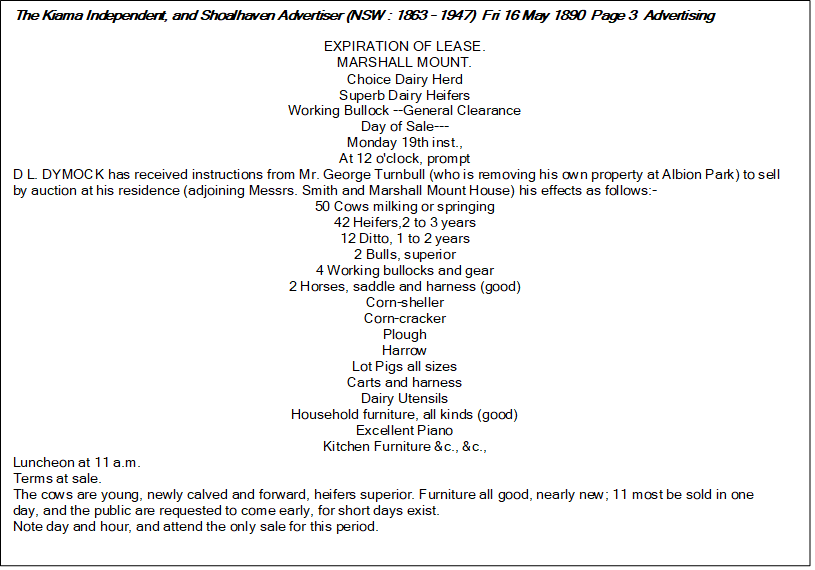
    1890 Estate Sale ad

    George appeared in the 1891 Australian Census living in his Albion Park home:

    Albion Park – Geo Turnbull – (No of Householder’s schedule) 100 – 2 males – 4 females

    This household was apparently comprised of George and Victoria and four of Victoria’s children. This information has not been proved.

    George died 27 Apr 1894 and Victoria provided a headstone for his grave, which was in the Presbyterian Cemetery at Albion Park, now the Pioneer Cemetery.
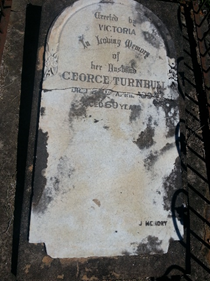
    George tombstone

    George’s Will was probated 7 Jun 1894.
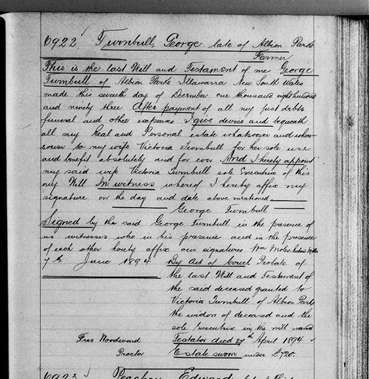
    George Will

    Victoria died 11 Jan 1911, and her son, John Smith entered an “In Memory” item in the South Coast Times and Wollongong Argus a year to the day after Victoria’s death:
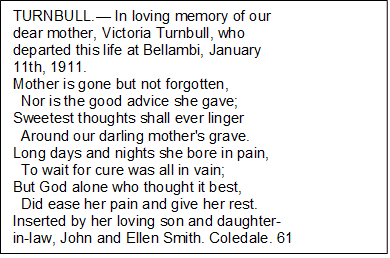
    Victoria memorial

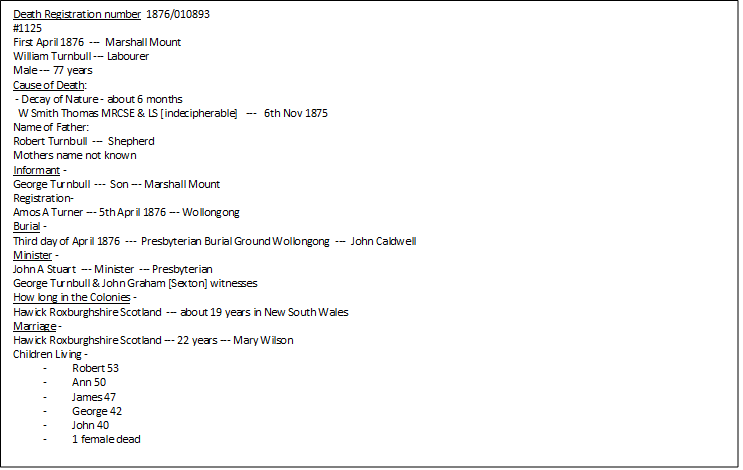
    William Turnbull died on 01 Apr 1876 at Marshall Mount.
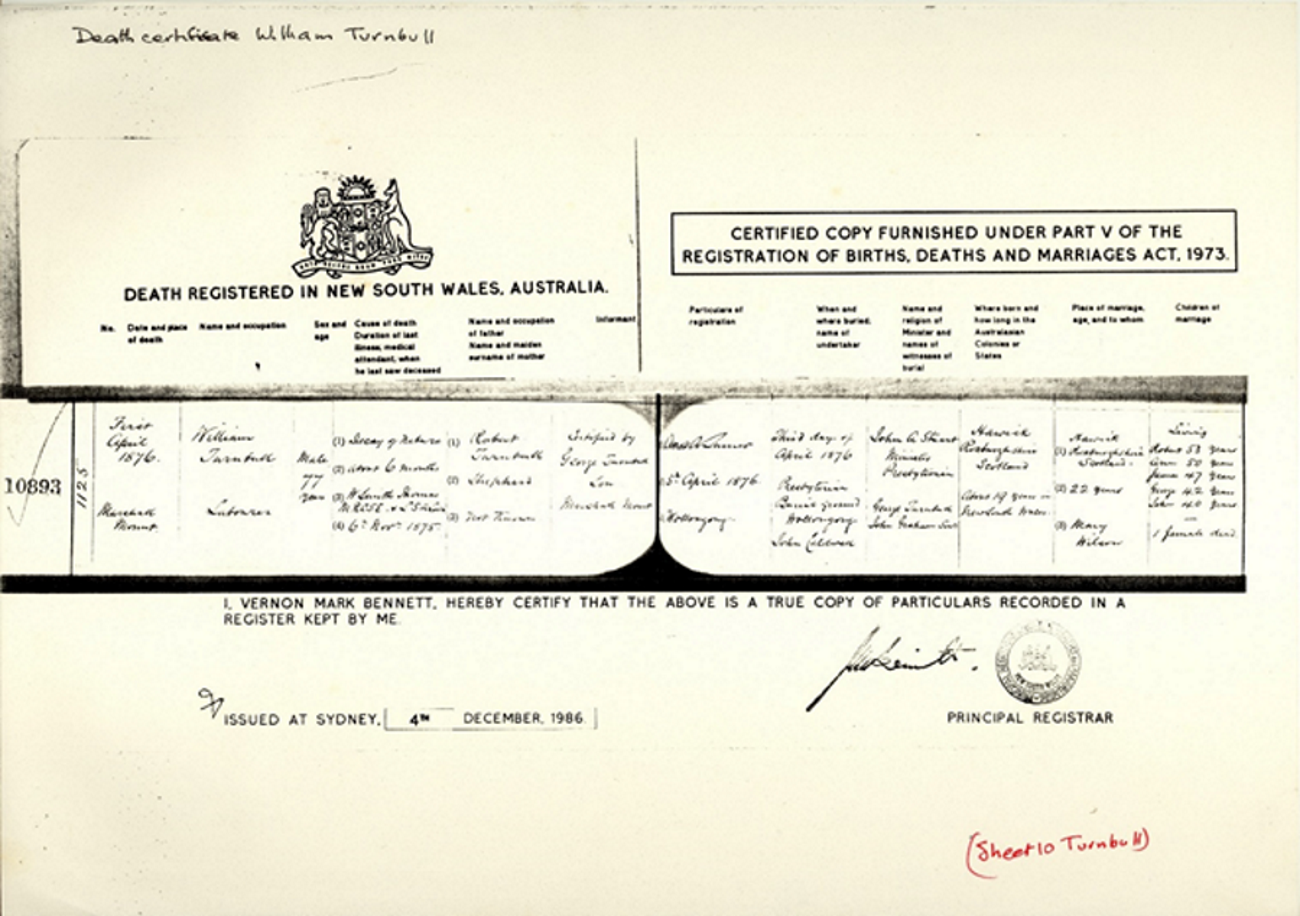
    Turnbull William Death certTurnbull William Death cert transcription

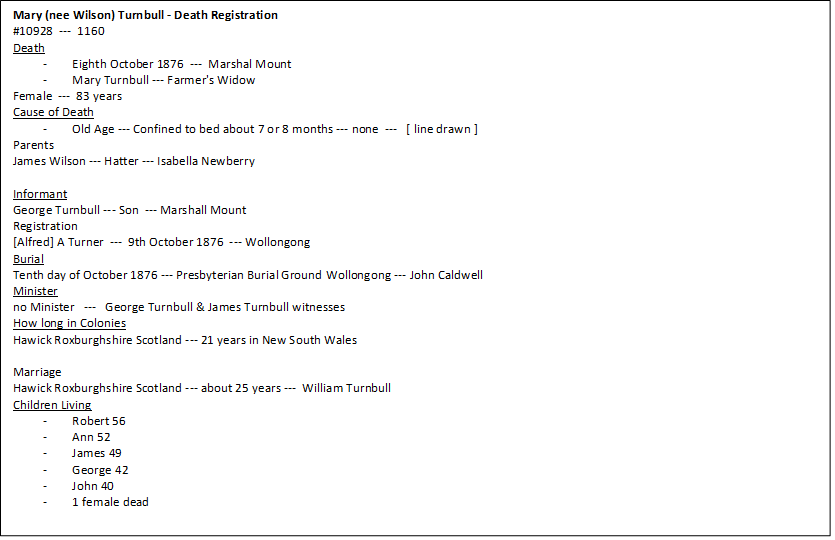
    Wife Mary Wilson Turnbull died 5 months later, on 08 Oct 1876.
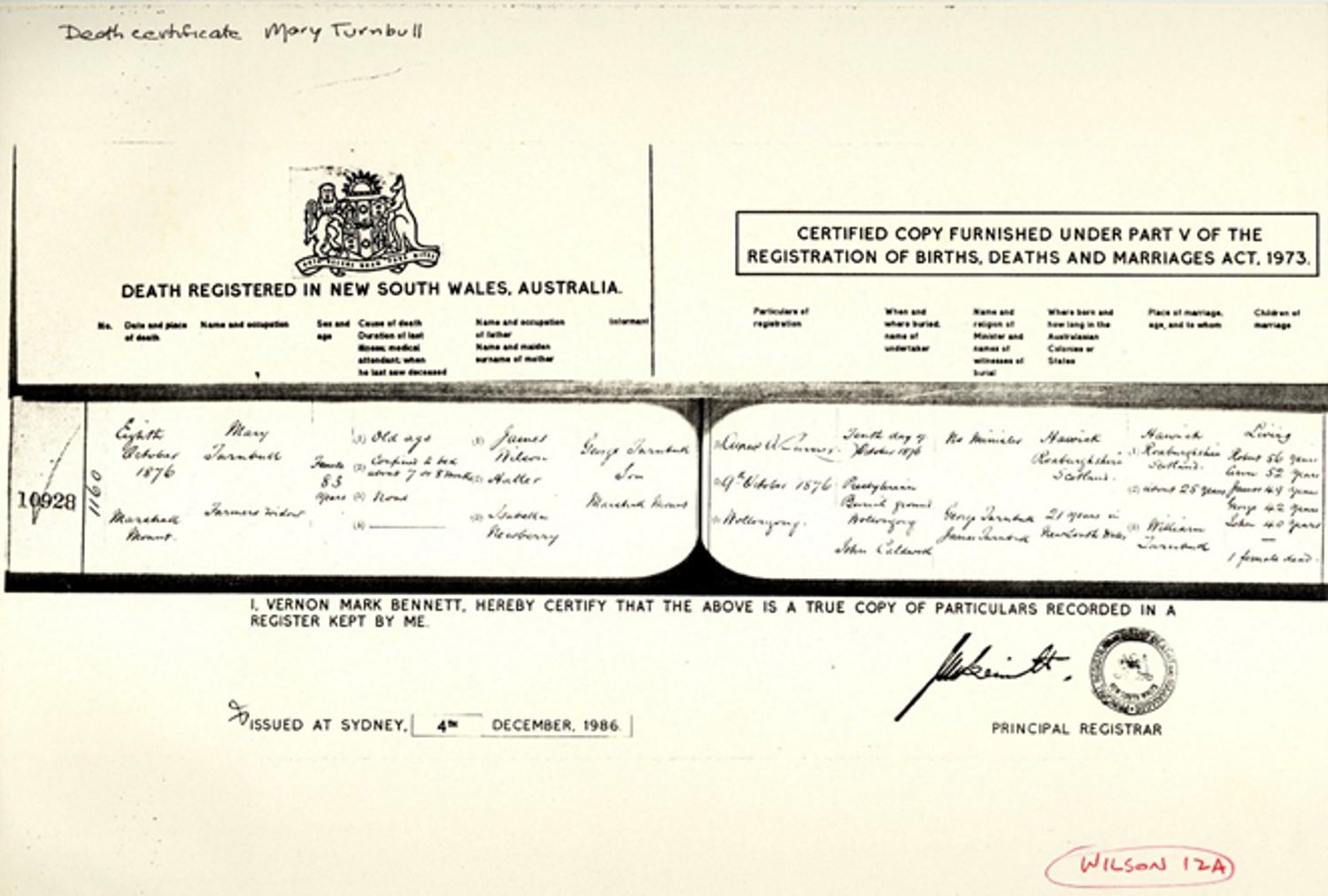
    Turnbull Mary Death CertTurnbull Mary Death Cert transcription

    Son Robert died 30 Sep 1891 at Brown Street St Peters and is buried in the St Peter’s Anglican Churchyard.

    Elizabeth died 26 Apr 1911 at her home at 46 Brown Street St Peters, and is buried at St Thomas’ Enfield; one of her daughters was living in Enfield at the time of Elizabeth’s death.

    Their daughter Jane Turnbull married Henry Miller (born Henry Miller Dixon in Coventry in Jan 1836) on 30 Oct 1872 in Redfern. They had three children:

    • A girl born and died about 1873
    • Harriet Maude Miller born 06 Sep 1874 at Thompson Street, Darlinghurst, married Charles Valentine Munro in 1894:
      • Alice Munro born 1895
      • Edmund (Ted) Harry Munro born about 04 May 1899

    Sadly, Harriet Maude died from septicaemia at Ted’s birth.

    • Harry Frank Turnbull Miller born 05 Jun 1881, married Isabella Sarah Hardy on 20 Oct 1906 at Kurri Kurri, and they had:
      • Mildred Elizabeth Isabel Miller born 1907
      • Henry Edmund “Harry” Miller born 1909
      • Stanley Robert Miller born 1912
      • Elsie Enid Miller born 1914
      • Jessie Maud Miller born 1917
      • Lorna Hazel Miller born 1918
      • Alan Edgar Miller born 1921
      • Denison Hunter Miller born 1923
      • Harold John “Jack” Miller born 1927

    Harry Frank enlisted in the 2nd NSW Mounted Rifles in 1901 and fought in the Boer War in South Africa. He died in 1950. His wife Isabella Sarah died in 1971.

    Henry died 28 Jul 1906 and Jane married again to Edmund Williams, a miner from Cornwall on 10 Sep 1906.

    Jane Turnbull Miller Williams died at the age of 89 on 16 Jun 1942 at Mayfield and is buried in Sandgate Cemetery. She and Henry had moved to Newcastle after their marriage. Jane had bought quite a lot of property in the Newcastle area, especially land along Railway Street in Hamilton.

    Oh, and I’ll bet you’re asking about William and Mary’s daughter Ann, who had been transported to Van Dieman’s Land!!!

    Ann had been sentenced to 10 years transportation. Having arrived in VDL on the ship CADET (3) on 12 Apr 1849, she was in/at the Brickfields Hiring Depot 06 Apr 1852. The next day, 07 Apr 1852, she was assigned to J Webb of “Little Hampton”. After that, she was assigned to William Crooke of Elizabeth Street, Hobart.

    She had her Ticket of Leave granted on 22 Feb 1853 and her Conditional Pardon granted 21 Feb 1854, then approved 19 Dec 1854. On 14 Apr 1858, she was considered “Freed by Servitude”.

    On 22 Jun 1853, she married another convict, William Weedon, in Bishopbourne, having been granted Permission to Marry.

    Ann and William had five children:

    • William born 01 Apr 1854 in Oaks, Tasmania
    • John born in 1855
    • James born 20 Apr 1857 in Oaks
    • Ann or Annie born 21 Nov 1858 in Westbury
    • Robert George born 19 Oct 1867

    Ann died 02 Jan 1901 in Glenore, Tasmania. It was said that her children were all named for the men in her Turnbull family – William, John, James, Robert and George. Someone once commented that they thought her brother, John Pott Turnbull, had visited her regularly in Tasmania, but I have not found any proof that any of her Turnbull family made contact with her.

    Footnotes

    [1] Data from “Female Convicts in VDL database” – Ann TURNBULL – Id 3187 – Police ID 347

    [2] As indicated previously, George Turnbull arrived in Geelong on 25 Dec 1852 per the ANN THOMPSON.

    [3] James Griffin had a brother JOHN GRIFFITH (hence the change to Griffin to avoid confusion on having two J. GRIFFITHs).


  • Edward COMBER b1820 Spitalfields

    It has only taken two years to finally find Edward COMBER b1820 in Spitalfields, Middlesex, England!

    Edward is my 2ndGreatGrandfather, and he has been an elusive man, to say the least.

    Over the years I have been searching, I have found numerous mentions of Edward but with conflicting information. The worst situation is the conflation of two men (Edward COMBER and Edward COMER) into one “super-Edward” who appears to have two wives and families over 200kms apart (please refer my post “Edward COMBER vs Edward COMER” for information I found in 2015).

    I was recommended to hire a Genealogical Researcher in the UK, which I did in August 2017. Rita has been quite diligent and has uncovered some of Edward’s secrets!!!

    Edward was indeed born in Spitalfields in/around 1820. While there is no Baptismal Registration found, as yet, there is a Workhouse entry for Edward aged 4, and his family. Yes, I have a family for Edward – I am so happy!

    Edward was born to James Comber and his wife Elisabeth. Edward had an elder brother, James Robert born 03 Nov 1818 while the family was living in Cock Lane, Smithfield, Middlesex, England which is very near Spitalfields. A sister, Elizabeth,  was born to the family in December 1824 and another sister, Ann, in/around 1827.

    Father James Comber was apprenticed as a weaver, but there are no Guild Records available that show he actually became a weaver. What we do know now is that James senior enlisted in the 50th Regiment of Foot (also known as Queen’s Own) in 1826. Brother James Robert also enlisted in the 50th Regiment of Foot in 1832, as a Drummer. [Refer my post “James Comber – NOT a nice man…“]

    The family moved with the Regiment, firstly to Ireland, then to NSW where they arrived in 1835 on the ship BLENHEIM as Guards on the Convict Transport. The Regiment was stationed in Windsor, just north of Sydney.

    Edward also enlisted in the 50th Regiment of Foot once arrived in Windsor in October 1835.

    Father James was discharged from the 50th Regiment on 31 May 1836 and he and Elisabeth apparently remained in NSW. Another daughter, Matilda, was born in NSW in 1837.

    Meanwhile, the 50th Regiment departed NSW for India, being stationed in Cawnpore (present name Kanpur) in Uttar Pradesh. Both brothers fought in the Gwalior Campaign in December 1843. Sadly, brother James Robert died in May 1844 in Cawnpore, and Edward was discharged from the 50th Regiment while stationed in Chinsurah & Loodianah in November 1845.

    Edward was back in NSW by 1849, where he applied for an “Irish Famine Orphan” with the NSW Colonial Secretary.

    He was obviously granted an orphan, as he and Elizabeth Mackey were married in Sydney in 1851!

    So – there he is – Edward COMBER – found him, at last!!!

  • Edward COMBER vs Edward COMER

    For such a long time, I have been looking into the COMBER family in NSW.

    I was so happy to find a lot of information on the internet about the man my 2Greats Grandmother, Elizabeth Mackie (also Mackay, McKay, McGee – lots of variations) married in 1851, in Sydney, New South Wales.

    I’m of the impression, now, that, looking at research results on sites like Ancestry and MyHeritage, people have tied what I believe to be two different men together to form one “mega-man”.

    My guy is Edward COMBER, died 1900 in Armidale. Edward Comber married Elizabeth Mackie/Mackay in 1851. They lived in Mulgoa, at Fernhill, for the remainder of the 1850s then moved north and their descendants are found in Muswellbrook, Tamworth, Coonabarabran, Narrabri – all over the north of New South Wales.

    It is thought that Edward COMBER was born in or near Spitalfields on 20 Dec 1820. At least, that is what my Grandmother said! Sadly, I have not been able to find any reference to COMBERs in that area for and around that date. I have, however, found an Edward born 1822, and a family called LE COMBER.

    Edward and Elizabeth (Mackay) COMBER had the following children:

    • Edward Comber (1852 – 1927) married Margaret Janet Johnstone
    • Elizabeth Comber (1853 – 1927) married Robert Hardy
    • James Coomber (1855 – 1927) married Matilda Dewson
    • Agnis Comber (c1856 – ?)
    • John William Mackay Comber (1857 – 1941) married Annie Barnes
    • Ann Tereasa Comber (1858 – 1939) married James Walter Buckley
    • Sarah Amelia Comber (1860 – 1941) married Thomas Leonard
    • George Westby Walker Comber (1862 – 1945) married Anna Maria Chilvers
    • Matilda Comber (1863 – 1867)
    • Mary Jane Comber (1865 – 1930) married Henry Chadband
    • George Comber (1867 – 1867)
    • William Henry Comber (1868 – 1945)
    • Margaret Louisa Comber (1872 – 1953)
    • and an un-named baby boy

    The other fellow is Edward COMER – he and his wife Ann (nee O’Rafferty) arrived in 1841 as Bounty Immigrants from Galway, Ireland per the ship RUNNYMEDE. Edward was born in/around 1816 in Ballynakill, Galway, Ireland and married Ann around 1840 in Galway.

    They had the following children in the Mudgee area:

    • Bridget Theresa Comer (1842 – 1934) married James Edward Callaghan (1838 – 1898)
    • Thomas Comer (1843 – ?) married Ellen Palmer
    • Michael Comer (1846 – 1918) married Emily A Catalin (Catabino)
    • Maria Comer (1848 – 1919) married John Boyling
    • Edward Comer (1854 – 1874)
    • John Henry Comer (1856 – 1936) married Mary Jane Johnas
    • Rebecca Comer (1859 – 1901) married James Ritchie

    The COMERs settled and lived in the Mudgee area until their deaths.

    I have proved, just recently (19 July 2015), that these are two separate men, after a visit to the Mudgee Family History Group to view their records for the area.

    So, my belief is that there is no way that one man could father 20+ children to two women over 200kms apart has been successfully supported!!!

    I am hoping that someone, somewhere, is looking into my Edward COMBER, too, and am happy to share my info to further the Comber family!

    UPDATE! – 2017-11-15 – Please refer to genimagus.wordpress.com/2017/11/15/edward-comber-b1820-spitalfields/

  • Ann Territt (aka Ann Terrett)

    Ann Territt (aka Terrett)

    She was born in or around Gloucester between 1786–1789.

    She was tried before the Gloucester Easter Quarter Sessions in 1810, charged with larceny. At that time, Ann had been a servant. She received a seven year term and was kept in prison for another two years prior to her transportation. Ann was first sent to NSW in 1812 aboard ‘Emu’ with about 40 female convicts on board. The ship was hijacked by American privateers and the passengers and crew were put onto the Cape Verde Islands until they were picked up and returned to England.

    Ann was re-sent to Sydney on the ‘Broxbornebury’, which left England on February 22, 1814.

    She worked at the female factory in Parramatta and one year later was given leave to marry William MAKEPEACE. She was given her freedom and after William’s death, she was listed as the publican of the ‘Black Swan Hotel’ in Sydney.

    Ann next married John WHEELER, a convict who had been assigned to work for Ann in 1826.

    Ann’s son, Jonas Wheeler, married Rebecca Hoy, daughter of Timothy Hoy (Admiral Gambier, 1808) and Bethia Freeman (daughter of James Freeman, Alexander 1788 and Mary Edwards (Mary Ann 1791).

  • Timothy Hoy

    TIMOTHY HOY (1782-1838)
    Timothy was born in Herefordshire, Essex, England. He was tried for breaking and entering the dwelling house of James Hawkins at Thorley, and stealing various articles of wearing apparel valued at £52.10s.0d. He was convicted at the Lent Assizes in Hertford in 1807 and sentenced to death. This was changed to transportation for 7 years. He came on the ship “Admiral Gambier” (1), which departed Portsmouth on 2nd July 1808 with 200 male convicts. The voyage took 171 days, arriving in Sydney on 22nd December 1808. Three convicts died on the voyage.

    Timothy was a brickmaker and stonemason, and helped in the construction of St Luke’s in Liverpool. In 1811 he married Bethia Edwards (1794-1864), daughter of James Freeman (Alexander 1788) & Mary Edwards (Mary Ann 1791). He was granted a Conditional Pardon by Governor Macquarie on 31st January 1820, and was granted land at Liverpool 5 months later on 1st July 1820. On his pardon he is described as 5 ft. 6 1/2 in. tall, dark ruddy complexion, brown hair and hazel eyes.

    In the 1822 Muster he was also renting land from Mr Dixon, with 15 acres of wheat, 1 of barley,1 horse, 2 horned cattle, and 2 hogs. This was most probably John Dickson, the husband of Susannah Martin, Bethia’s half sister. In the 1828 Census he had 100 acres at Liverpool called ‘White Hills’, 43 cleared, 30 cultivated, 4 horses, 30 cattle, and 1 convict working for him, named Begley.

    Timothy and Bethia had 11 children; William, James Harris, Susannah, Mary Ann, James, John, Elizabeth, Timothy, Regecca, Henry & Charlotte. Timothy died on 28th July 1838, and Bethia died on 1st December 1794. They were both buried at St Luke’s in Liverpool, Sydney

  • Mary Edwards (nee Mary Hopely, Mrs William Edwards)

    Mary Edwards was a convict aboard The Ship Mary Ann which sailed from England, on Wednesday, 16 February 1791 and arrived in Port Jackson on 9 July 1791, the first ship in the Third Fleet to arrive in Sydney. The ships Master was Mark Munroe. 

    Mary Edwards (maiden name Mary Hopely), wife of William Edwards, was born around 1766 in Herefordshire.

    In August 1789, both of them were arrested in Leominster where they then lived, and charged (Hereford 9 MAR 1790) with stealing shoes etc from a shop. William was acquitted, Mary sentenced to 7 years’ transportation. (It was that time in NSW history when the appeal had gone out for More Women, to redress the imbalance.) Mary was confined in Hereford Gaol until her departure aboard “Mary Ann” in February 1791.

    She lived with James Freeman, eventually married Abraham Martin, she retained her first husbands name from England.

    She had two children with James Freeman (Alexander 1788), Mary 1792-1801 and Berthina or Berthia 1794. Berthia married Timothy Hoy (Admiral Gambier, 1808). She had one child, Susannah 1800, with Abraham Martin.

  • Christopher Nowlan (aka Christy, aka Nolan)

    Christopher NOWLAN (also NOLAN) came here as a convict in 1826 on the ship Phoenix III, arriving 25 Dec 1826.
    He was tried in Trim in 1826 for Murder.
    He was 23 years old
    Sentenced to LIFE, he got a ticket of leave and a conditional pardon.
    He got permission to marry a Mary EDWARDS (daughter of Matthew Edwards, Portland 1833) in West Maitland who was aged 15 years and she came free (not a convict).
    Christopher’s calling or trade was Farmers Man.

  • James Freeman (Update)

    James was born in Watford, Herefordshire, England, around 1768. He lost his father when less than 18 months of age. By his teens, he was associating with a gang of thieves. In August 1783, James and his accomplices, Thomas Taylor & Thomas Rust, stole a watch & chain and a seal, worth eleven shillings, from John Seymour of Watford. On 11 Dec 1783, James and Thomas Taylor stole a half guinea, a shilling and sixpence from Thomas Baldwin. Thomas Taylor stole again in January 1784. Thomas Taylor, aged 30, & Thomas Rust, aged 21, were both hanged. 

    At 16 years of age, James was tried at the Lent session of the Hertford Assizes on 3rd March 1784, by Sir William Henry Ashurst Knight & Jerome Knapp Esq. Justices. He was convicted of highway robbery on the King’s Highway at Aldenham and was sentenced to death by hanging, but this was changed to 7 years transportation. This was the first prosecution from the Hertfordshire County which resulted in the convict being transported. He was sent to the Justitia hulk, where he spent 3 years before being transferred to the Alexander on 27th February 1787. 

    Three months later, at 19 years of age, he sailed from Portsmouth with the First Fleet on 12th May 1787. There were 11 ships commanded by Captain Arthur Phillip, who was commissioned as the first Governor of Australia. The 15,000 mile journey took just over eight months. The Fleet anchored at Botany Bay on 18th January 1788, then finally settled at Sydney Cove on 26th January. It arrived with 717 convicts, of whom 180 were women, guarded by 191 marines under 19 officers. The convicts’ average age was about twenty-seven years. The Alexander was Captained by Duncan Sinclair. It was the ship that had the most number of deaths on board. Sixteen deaths occurred before the ship had even set sail, mostly from typhus. 

    Four weeks after their arrival, on 27th February 1788, James was again in trouble for stealing flour, with a mate, William Shearman from Berkshire. They were charged with feloniously and fraudulently taking and carrying away 15 half pounds of flour valued at 15 pence, the property of Michael Dennison, Robert Abel, and William Waterhouse. Shearman was sentenced to receive 300 lashes, and James was sentenced to death. He received Australia’s first Conditional Pardon on 1st March 1788, on the condition that he became the Public Executioner till he served out the remainder of his sentence, and remain in NSW for life. So James became Australia’s first hangman. He was reluctant to do his duty but complied when the Marines were ordered to shoot him. After he served out his sentence he worked as a farmhand. 


    James earned 100 lashes and stoppage of his grog 11 Dec 1789 for being drunk and out of his hut after 10.45pm, this was only two weeks after he had to hang Ann Davis. He remained a labourer, labouring at Richmond N.S.W. He died a pauper at Windsor 28 Jan 1830, buried St Matthew’s Anglican Church in an unmarked grave, aged 67.

    He had two children by Mary Edwards (maiden name Mary Hopely (Maryann 1791)) [q.v. https://goo.gl/F1hwKw], Mary 1792-1801 and Berthina or Berthia 1794. Mary Edwards had left him by 1800 for Abraham Martin.

  • James Freeman

    I’m in the process of conversing with a distant relative located in New Zealand, and “my old pal” James Freeman entered the conversation.


    James is an interesting character. Not much is known (by me!) about his early days. My research has shown he was convicted in Hertford, Hertfordshire, at the Assizes in 1774.

    Transported on the ship ALEXANDER, he arrived with all the other First Fleeters in Sydney Cove in 1788. As may be known, the First Fleet arrived with only half the planned supplies (due to Admiralty incompetence and greed), so the colony was in dire straights by the end of the 1st month and all on Australian soil were on half or even quarter rations.

    Freeman was tried with William Shearman for stealing 15 allowances of flour, sentenced to death, pardoned on condition he became the public hangman. He had to hang that day Thomas Barlett (qv) reluctant to do so, the marines had orders to shoot him, if he didn’t do so.

    James went on to be assigned as a laborer to a fellow in the Windsor/Richmond area, north west of Sydney.  Upon his Absolute Pardon he continued to live in the area.

    He remained a labourer, labouring at Richmond N.S.W. He died a pauper at Windsor 28 Jan 1830, buried St Matthew’s, aged 67.

    He had two children by Mary Edwards (arrived as part of the Third Fleet on the MARYANN in 1791), Mary 1792-1801 and Berthina or Berthia 1794. Young Mary died aged 9, and Berthia married Timothy Hoy (Eighth Fleet 1808). Mary Edwards had left him by 1800 for Abraham Martin

  • James Bird HILL (1 Mar 1801 – 31 Jul 1839) – (originally posted as a Page on this site 2012/05/29)

    James Bird Hill was born in Burton Overy, Leicestershire, England on 1 March 1801 to parents James Hill and Catherine Bird.

    James Bird Hill enlisted in the (now) Queen’s 2nd Royal Regiment of Foot; the Regiment is known to have been stationed in Dublin, Ireland, Bombay (Poona [now Pune] and Colobah) in/around 1832 and also Ghazni, Afghanistan in 1839.

    James enlisted under the name of James Bird, and married Ann Jarvis in September 1820, before the Regiment was moved to Ireland.

    The Regiment was posted to Bombay, and was eventually engaged in the First Afghan Wars. James Bird Hill was reported to have died in Ghazni (after the first battle of Ghazni) of Typhoid and starvation on 31 July 1839.